
NOTE: This story also appears today on our sister siste, www.leblanguage.net. Please visit it regularly for musings on media, politics and life.
The Olympics are providing an awful lot of wonderful stories so far at a time when they are SORELY needed. Many involve the expected that had had previous glory and notoriety, such as the stirring comeback performance of Simone Biles, the record-setting individual medal count of Katie Ledecky and, frankly, the ratings level of the NBCU family of networks and platforms. The ones that are the most stirring to me are the ones that seem to come out of nowhere.
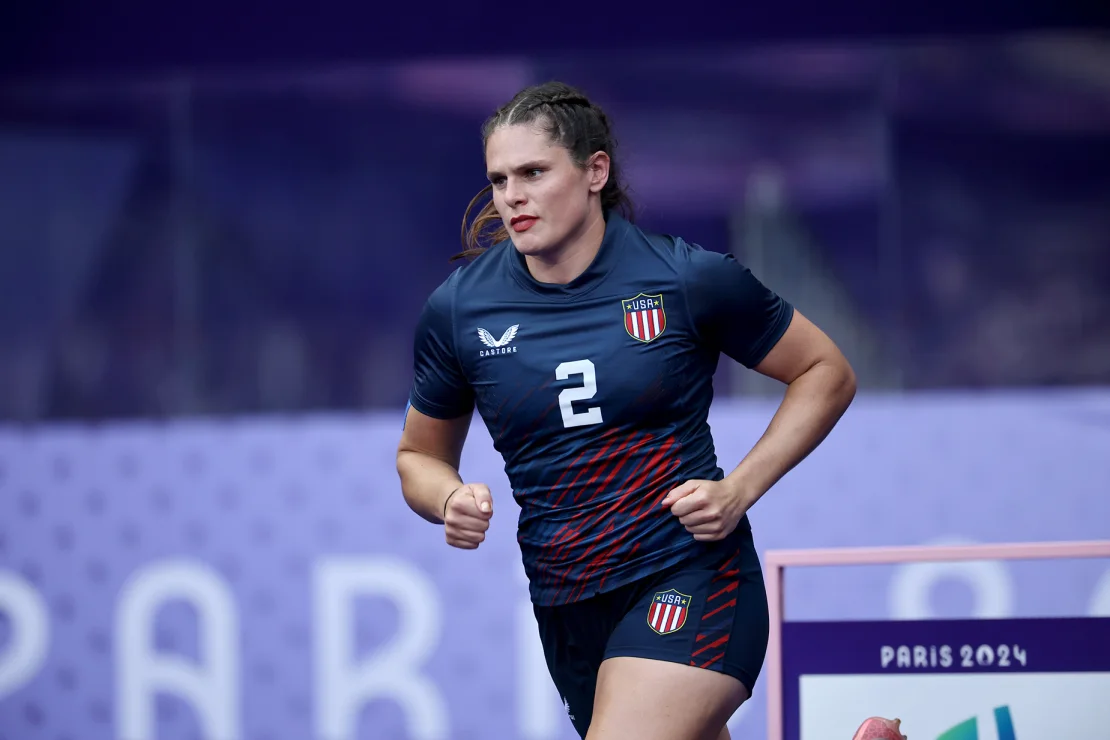
Then again, I probably wasn’t paying as much attention as I should have during the Tokyo games of three years ago, what with odd hours, virtually no crowds and the pall of the earlier days of the pandemic hanging over that summer’s competition. Had I, I might have noticed what an awful lot of younger fans, particularly heavy social media users, already did about how much of a hoot one Ilona Maher is.
As NPR’s Rachel Treisman wrote:
The 27-year-old Vermont native has been an athlete to watch — both on and off the playing field — since the Tokyo Games in 2021, when she charmed the world with her honest review of the controversial cardboard beds, blunt takes on the Olympic Village social scene and other behind-the-scenes looks at the highly-restricted pandemic-era Games.
The fact that she represents a sport that is somewhat off a lot of folks’ radar–women’s rugby–might have muted her spotlight for an awful lot of you. But, in hindsight, I had no such excuse, since I learned long ago about the dedication and appeal of ladies who are tough enough to play what is arguably a rawer and more brutal version of what we mere mortals call football, and unlike the women who have attempted such efforts in that sport there are no flags and certainly no lingerie.
When I first got to college in upstate New York, I quickly learned that rugby had a strong regional following in that area, and since my school had recently dropped football from their athletic program there was an extra large void in the fall. But in the wake of that controversial financial decision they refused to fund varisty teams, leaving those interested with the need to find alternative ways to fund club teams and schedule matches against nearby schools in similar situations as well as independent squads willing to schlep to our campus for games. And the women’s team was especially aggressive in seeking publicity for their games, something I learned shortly after I took over the vacant sports editor position for the campus newspaper.
 An imposing Amazonian in striped green and gold strutted into our office and specifically asked for me. She looked an awful lot like Lynda Carter, then TV’s WONDER WOMAN, only taller and with the forearms of a derrick. She explained that my predecessor had determined that since they weren’t a school-sponsored team the paper had refused to cover their games and was hoping a new face might be more receptive. Ever the rebel, and frankly intimidated as hell by those forearms, I said, sure, but I was still trying to find sportswriters willing to cover the games of the actually funded teams. She confidently said “I’ve taken journalism class; I can write them up for you. But it’s hard for me to find a place to use a typewriter; our house is usually partying too hard. You let me come in and use one of yours and I’ll be your sportswriter”.
Yes, it was THAT long ago where typewriters were needed and, frankly, I was in no condition physically or staffing-wise to refuse. But at a time when many of my so-called more dedicated staffers were often late or lazy with their articles, “Wonder Woman”, like clockwork, would come by on a Monday or Tuesday morning when I had office hours and pound out a good 600-800 words filled with game descriptions and even a few personal anecdotes about a stray punch or two she may have incurred–or caused. In one article where the team lost by a large margin she simply put down the final score and wrote “Since you’re reading this in the school paper, you probably don’t care much about the details of how badly we were beaten, so let me answer a few questions you may have about how this sport is played or scored”. She bonded with our office assistant, effectively our house mother, and just about anyone else who was in the office at the time. When we decided to hire an associate sports editor, her name was immediately suggested as a candidate, and I was only too happy to offer it to her. And, frankly, she was damn good even with sports other than rugby.
So I probably should have known the potential power of women’s ruggers. Turns out an awful lot of the world already did, as Treisman detailed:
Just days into the Paris Olympics, Maher officially became the most-followed rugby player on Instagram with 1.4 million followers, a number that’s since grown to 2 million. She has 1.9 million and counting on TikTok. Maher’s social media star has only grown…zince. She’s used the platform to bring attention to women’s rugby and spread messages of body positivity, including popularizing the hashtag #beastbeautybrains (her sister Olivia, by the way, is the creator of #girldinner).
And that star only grew when her team provided one of the more thrilling and historic moments of the Paris games earlier this week, as MASHABLE’s Tim Marcin gushed:
 USA women’s rugby won the bronze medal at the 2024 Paris Olympics — the first-ever podium for the U.S. in rugby — in what might be the most dramatic fashion imaginable. The team won on a wild, last-second, full-field run to clinch the victory. It’s hard to overstate how freaking cool the play was. I’m no rugby expert but it was basically the sport’s version of a Hail Mary completion to win the game in football. Well, that combined with a powerful run right up the gut. The U.S.’s Spiff Sedrick just straight-up bulldozed through an entire team.
As NBC New York more calmly explained:
The U.S. women their first Olympic rugby sevens medal with a stunning stoppage-time comeback win over Australia in the bronze-medal match on Tuesday. The 2016 champion Australians were leading 12-7 with seconds remaining and deep in U.S. territory. The ball went to Alex Sedrick and she bumped off two tacklers before racing the length of the field, all the way to the other end to score and spark jubilation for the Americans.
For those unfamiliar with the sport: What occurred would basically be similar to a 90-yard score on the final play of an NFL game as time expired.
And with that, coupled with Maher’s platform, a LOT more people now know about women’s rugby.
I draw some comparisons to what happened to women’s soccer in the wake of Brandi Chastain’s World Cup-winning goal, establishing her own celebrity alongside perhaps that sport’s equivalent at the time to Maher, Mia Hamm. No, neither Sedrick nor Maher removed their jersey, but Maher did use her reach to bring herself and her sport into even loftier neighborhoods of zeitgeist, as PEOPLE’s Angel Saunders reported this morning:
Ilona Maher and Simone Biles are bonding at the 2024 Paris Olympics.
In addition to being the best of the best in their respective sports, the American rugby union player, 27, and the American artistic gymnast, also 27, have even more in common than going for the gold!
 “So we all know iconic Simone Biles,” Maher, who helped Team USA win bronze in the rugby tournament on Tuesday, July 30, began in a TikTok video posted on Thursday, Aug. 1. The athlete explained, “Simone Biles made her own custom pins, and my sisters made custom pins for me as well.” While recording, Maher focused the camera onto her special accessory. “So, I gave my custom pin to Simone, and she’s gonna give me hers,” Maher continued.
It’s no surprise that earlier this week the esteemed sports branding expert David Neiman authored a compelling compendium on his ATHLETE INTERACTIVE site of why Maher is not only ideally suited to be the face of a sport that bodes to be the next to take advantage of the growing potential–and money–of women’s sports in general, but as a father of two teenage girls, she’s as desirable a role model as any girl dad might desire.
 I’m glad he feels that way, as I suspect a lot of other girl dads are now coming around to realizing. But although for me that’s a moot point, I arguably knew way before that what qualifies someone as a true Wonder Woman. They don’t necessarily have to play rugby. But it helps.