
NOTE: This musing also appears today on our sister site, Leblanguage. Please visit it regularly for extended coverage of media, politics and life.
I am unapolgetically a huge fan of Kelly Kahl’s, and not just because he ultimately rose farther than just about anyone else who once called research his calling, ultimately becoming the president of CBS Entertainment during a tenure where they were consistently America’s Most Watched Network. What I learned from direct observation is that no matter how high he rose he never did not make time to directly connect with his staffers and his roots, dropping in unannounced on numerous focus groups I jointly conducted with his colleagues, never failing to ask detailed questions about recruits and dials and always making sure to check on how myself and my sometimes stunned colleagues were doing, surprised that a network president would bother with something they considered so minor.
High position or not, he was essentially the same person I first encountered decades earlier as he was a rising star at Lorimar Television, where he caught the eye and developed a strong bond with Les Moonves that resulted in him coming along to Warner Brothers and then CBS with him in the 90s. And before anyone starts to trash Moonves given his ultimate fate, allow me to remind you that personal behavior aside you’d be hard-pressed to find an executive with better instincts and loyalty to his trusted allies than him, and his track record backs that fact up. Kahl indeed benefitted tremendously and I came to learn that despite our different backgrounds we approached our careers and passions quite similarly. He loved getting in at the crack of dawn to access and process overnight ratings for premiering shows and being the first in the building to know the good news. He loved winning. And he absolutely loved Wisconsin sports, and especially the Milwaukee Brewers, even more than that.
So I’m especially happy that his first significant project since he departed CBS is one that allows his passions of storyelling and fandom to collide, and tonight the byproduct is premiering. This morning THE MILWAUKEE JOURNAL SENTINEL’s Chris Foran shared some details and context with his readers:
There may be no season of a Wisconsin sports team that has been written about, celebrated or remembered with affection more than the 1982 Milwaukee Brewers.
But a new documentary on the only Brewers team (so far) to make it to the World Series shows that there’s always something new to learn — or at least, some new stories to tell.
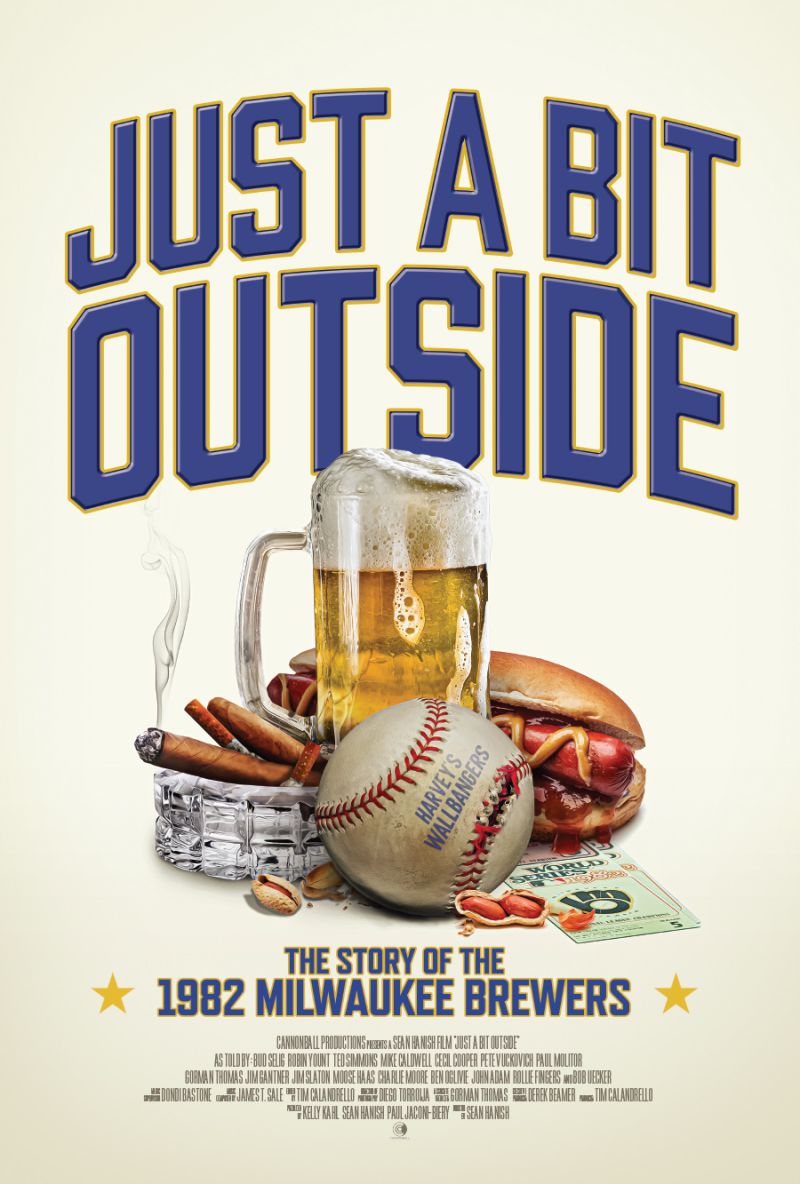
 Debuting in Marcus Theatres in Wisconsin Friday, “Just a Bit Outside: The Story of the 1982 Milwaukee Brewers” is a love letter to the team by two Wisconsin natives: producer-director Sean Hanish and producer (and former president of CBS Entertainment) Kelly Kahl.
The movie features interviews with players from the 1982 Brewers — familiar faces including Hall of Famers Robin Yount, Paul Molitor, Ted Simmons and Rollie Fingers, and less-interviewed players from that team, such as Jim Slaton, Moose Haas, Ben Oglivie and Charlie Moore — along with owner Bud Selig, Hall of Fame announcer Bob Uecker and trainer John Adam.
Foran does an outstanding job at revealing some additional context for why this particular team, one that ultimately lost in seven excurciating games to the St. Louis Cardinals in what could have arguably been the most beer-centric Fall Classic ever, is so fondly remembered. The one I found was most transcendent was this one:
The 1982 Brewers players believed they had to win for their beleaguered fans
Pro athletes often are criticized for living life in a bubble, but the 1982 Brewers knew what their fans were up against, with rising unemployment, massive layoffs and high-profile companies like Schlitz disappearing from the landscape. “We knew they were really hurting,” Jim Slaton says of the Brewers faithful in an interview in “Just a Bit Outside.” “We were trying to give them something they could hang on to.”
 The Milwaukee most beyond the city limits knew at the time was the storybook era of the 1950s, the era of HAPPY DAYS and LAVERNE AND SHIRLEY. And in those times Richie, Potsie, Lenny and Squiggy rooted for the recently-transplanted and perennially last-place Boston Braves, the first major league team in more than half a century to relocate and ultimately begin the Western migration that eventually uprooted the lesser-performing teams in each city which had at least one representative in both the American and National Leagues. Milwaukee fell in love with the Braves and in their fifth season they shocked the baseball world by winning the franchise’s first world championship in 43 years, and knocking off no less than the New York Yankees in doing so. They rounded out the 1950s with a rematch series that the Yankees won, followed by a tie for the regular season pennant that resulted in a thrilling three-game playoff with the sport’s newest carpetbaggers, the Los Angeles Dodgers.
But nearly as quickly as that Roman candle took off, the Braves’ shaky financial grounds were exposed, and when they settled into a less competitive stretch they were ultimately wooed by the siren’s song of dollars and a then state-of-the-art stadium in the city where their top minor league city was based, Atlanta. And by 1966 Milwaukee no longer had major league baseball.
But thanks largely to the efforts of Selig, then a prominent local car dealer, and the immediate failure of the expansion Seattle Pilots, by 1970 the Brewers filled that void. But they had their troubles, both being an American League team in what was a National League city and failing to deliver competitive teams for much of their first decade. Even when they finally did taste success in 1981, it was tinged with disappointment–it came during a strike-split season where they ultimately only played good enough to qualify for an expanded post-season with a strong second “half”, and those damn Yankees won a decisive fifth “division series’ game.
Which sets up what I thought were the stronger sports-related points that Foran shared:
For a while, one of Wisconsin’s most beloved teams faced angry fans
Despite making it to its first postseason the year before, the Brewers struggled in the first third of the season to a sub-.500 record (23-24) before general manager Harry Dalton decided to fire manager Buck Rodgers and replace him with hitting coach Harvey Kuenn. The documentary features footage in which fans at County Stadium do something few looking back would think possible: They are booing.
The Brewers had had team nicknames before — like Bambi’s Bombers, during George Bamberger’s tenure as manager in the late 1970s — but the 1982 ballclub didn’t really develop a single identity during Rodgers’ tenure as manager. On June 5, three days after Kuenn was named to replace Rodgers, Robin Yount, Cecil Cooper and Ben Oglivie hit back-to-back-to-back home runs — part of a five-homer barrage that led to an 11-3 win over the Oakland Athletics, as recounted in the movie. After Dalton suggested the team be called Harvey’s Ballbangers, Cooper countered: “Naw. Just like the drink: Harvey’s Wallbangers. We keep banging ’em off the walls.” The name stuck.
 And then, a true summer of love ensued. The Yankees crumbled to utter mediocrity on the weight of George Steinbrenner’s overreactions, ultimately firing two managers in the process. In the American League Championship Series, then a best-of-five affair, the Brewers dropped the first two in Anaheim to the California Angels–ironically, led by their new acquisition Reggie Jackson. With no margin for error, they then rattled off three straight wins, the first even more ironically achieved by a castoff veteran starter from Southern California, Don Sutton.
In a smaller market like Milwaukee, and particularly one that sits so close to a market of consistent losing like Chicago, which at that time hadn’t seen either of their teams in a post-season since 1959, a run like this with a team this beloved is transcendent and generational. And while the current Brewers team, relocated to the National League by Commissioner Selig during the game’s last expansion in 1998, are regularly making it to post-season play of late (this year’s team currently sits with a magic number of 9 to clinch the Central Division title), they’ve yet to return to the promised land of the World Series that only the ’82 edition has reached.
Kahl, as he did as a CBS executive, hands out praise and accolade to many others besides the talented Hanish, and I know he would insist you readers know their names too:
 go time! massive thanks to all who helped us along the way…special thanks to tyler barnes and milwaukee brewers, potawatomi casino/hotel, miller beer, derek hildebrandt and pixelogic, paul pierandozzi and kustom creative, lussier tv, marcus theatres, mark kass and cole barnes at team lammi…wisconsin tv/radio stations and brewers podcasters! it takes a village……
If there is one disappointing coda to this tale, it’s that for the moment the movie is being limited to a theatrical run in Wisconsin. It’s not that Kahl can’t find the right people to connect with; it seems to be the case that no one has yet found a budget line where they can justify acquiring it. No, not even networks like MLBN and FOX that will be carrying the team’s post-season games.
I think those of us who aren’t quite up to hopping onto a flight deserve a chance to experience this, and get a better understanding of what drives real passion, even above and beyond successfully programming Thursday night comedies. Heck, maybe start a Kickstarter campaign. If not to help offset the cost of buying a TV window, perhaps enough to organize a screening in LA or NY where real fans of both movies and baseball can get a taste of the first real “Brat” summer.
Good luck and keep wallbanging, KK.