

Please sign up to get our Binary Response articles directly in your inbox!
Casual fans complained for many years that games were just too long. For most of the 2010s and into the early 2020s, sitting through a nine-inning game meant surrendering three-plus hours of your evening, and the league knew it was losing people because of it. So when MLB introduced its landmark rule changes in 2023 — centered around the pitch clock — it worked. Games got shorter. Fans came back. Attendance ticked up. Everyone applauded. Problem solved, right?
Well, not exactly.
Here we are in 2026, the first season of the Automated Ball-Strike (ABS) challenge system, and the average nine-inning game is already clocking in at 2 hours and 42 minutes. That’s up four minutes from the 2025 full-season average of 2:38 and up six minutes from 2024’s figure of 2:36, which was the lowest average game time since 1984. All of that progress achieved over three seasons of pitch-clock enforcement, is quietly beginning to unwind — not because pitchers are shaking off pitches or batters are stepping out of the box a lot, but because players and managers are now able to challenge pitches like it’s a tennis match.
There’s something genuinely ironic about this. The entire push to enforce the pitch clock was rooted in pace of play. MLB wanted to stop pitchers from staring into the catcher for 30 seconds and batters from adjusting their batting gloves after every pitch. It worked brilliantly. In 2022, the last season without the pitch clock, games averaged a bloated 3 hours and 6 minutes. By 2024, that number had dropped to 2:36 — a 30-minute improvement. The league was so proud of it that Commissioner Rob Manfred practically did a victory lap every fall. Baseball was back. It was snappy. It was fun.
And now the ABS challenge system is adding time back in — one brief interruption at a time — like replay review has done to every other sport that adopted it.
Both hitters and pitchers/catchers are each allowed a limited number of ABS challenges per game to dispute a ball or strike call. When a challenge is issued, the official ABS ruling gets reviewed and displayed on the ballpark’s video board, creating a moment of suspense before the decision is announced. Each individual challenge may only take about 15 seconds, but in a game where those challenges can pile up across nine innings, those seconds add up fast. Through the first few weeks of the 2026 season, there have already been 932 total ABS challenges across the league, with 54% of them being overturned. Pitchers and catchers are succeeding on challenges at a 61% rate, while batters are converting at 47%. That’s a lot of stoppages.
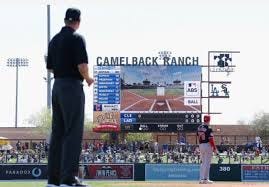
In an interview on The Dan Patrick Show last week, Commissioner Rob Manfred acknowledged the trade-off saying, That’s a price I’m prepared to pay. And look, he’s not entirely wrong. The ABS system is delivering accuracy something which is genuinely valuable. Calls that used to be blown with zero recourse are now being corrected in real time. That’s good for the integrity of the game. But you can’t simultaneously brag about how the pitch clock rescued baseball’s pace and then wave off a new system that’s taking those gains away without at least acknowledging the full picture.
What makes this particularly interesting is the attendance angle. Despite games being slightly longer, MLB is actually seeing a bump in attendance early in 2026. That’s encouraging and it speaks to the entertainment value the ABS challenges might be generating. Fans seem to enjoy the drama of the challenge call appearing on the video board — it’s interactive, it’s theatrical, and it gives people another moment to cheer or boo. So the longer games aren’t necessarily killing the fan experience. If anything, the ABS challenge has become a new kind of event within the event.
Here’s the thing, folks: The league cannot have it both ways when it comes to messaging. For three years, MLB used shortened game times as one of its primary selling points in its broader effort to attract younger fans. Now those times are creeping back up, and while the current 2:42 average is still dramatically better than the dark days of 3:10 in 2021, the direction of the trend matters. If the ABS system continues to add minutes as the season progresses and teams become more strategic about when and how they deploy challenges, we could be looking at consistent 2:45-plus games by summer.
With that… Baseball’s always had a complicated relationship with time. It’s a sport that famously doesn’t use a clock — which is either poetry or a scheduling nightmare, depending on who you ask. The pitch clock was the league’s concession to the modern attention span. The ABS system is now pulling in the opposite direction. Both can coexist. Both can make the game better. But let’s be honest about the trade-off we’re making, because pretending these things don’t have consequences doesn’t make the consequences disappear.
If you cannot play with them, then root for them!