

Please sign up to get our Binary Response articles directly in your inbox!
The Tigers misplayed the Tarik Skubal situation by refusing to treat year’s trade deadline like a sell‑high moment, and his elbow surgery has now blown up whatever trade leverage they had this summer. Instead of turning a back‑to‑back Cy Young winner into a franchise‑altering haul, they’re stuck hoping an injured ace regains value on a ticking free‑agency clock.
Skubal was scratched from his scheduled start against the Red Sox, and within a day the Tigers announced he needs arthroscopic surgery to remove loose bodies from his left elbow. A.J. Hinch said Skubal felt elbow pain over the weekend, just days after an earlier scare when he was shaking his arm during a start in Atlanta.
Right now there’s no firm timetable for his return, only the certainty that he’s on the injured list and not chasing a third straight Cy Young. Elbow surgery — even just loose bodies — is a giant red flag to any front office that was already wary of paying full freight for a pitcher, especially one with Skubal’s prior flexor tendon surgery on the résumé.
This is what makes Detroit’s approach so frustrating for fans. They sat on one of the most valuable pitching assets in baseball at the exact peak of his market. Skubal has had back‑to‑back Cy Young Awards, becoming the first AL pitcher to repeat since Pedro Martínez in 1999–2000.
Before the 2025 trade deadline, he was putting together a dominant season, leading the American League with a 2.00 ERA and ~12 strikeouts per 9 innings as well as multiple other WAR measures. He had firmly establishing himself as one of the most valuable arms in baseball. With that level of production and an additional year of team control still on the table, it’s the kind of profile that naturally drives conversations about blockbuster returns built around multiple premium pieces.
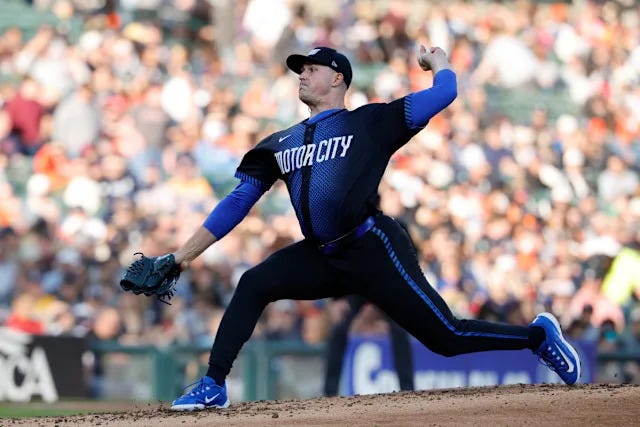
And the market was there. Reports up to the trade deadline had teams like the Los Angeles Dodgers, Chicago Cubs, and New York Yankees checking in while the Tigers set a sky‑high asking price and kept saying no. Detroit writers and national insiders framed it as a conscious decision to win now with Skubal at the front of the rotation. That sounds bold in July. But looks reckless the following season when he is in his last year prior to exploring free agency.
If you refuse to trade a pitcher at peak value, the logical counterweight is to lock him up. The Tigers did neither. Skubal himself told many sources that Detroit never discussed a long‑term extension with him this winter.
There wasn’t even meaningful dialogue about his 2026 salary after he filed at 32 million dollars in arbitration, because the club follows a rigid file‑and‑trial policy once figures are exchanged. On top of that, this comes after he already missed nearly 11 months following flexor tendon surgery earlier in his career, so it’s not like this was a totally clean medical profile you could just trust to age perfectly.
Meanwhile, the chatter around Skubal was that he’d likely become the highest‑paid pitcher in the league once he hits the open market after the 2026 season — which everyone around the team admitted would be very likely before his surgery this week. So Detroit didn’t trade him, didn’t extend him, and now doesn’t have a healthy version of him. That’s how you lose the value game on all three fronts.
The Tigers’ public stance was that adding Framber Valdez while keeping Skubal was about going for it in what might be their final year with their ace. On a whiteboard, pairing two frontline lefties looks like an aggressive push to contend in 2026.
But contention windows are probabilities, not slogans, and Detroit already knew they were betting on a pitcher with one significant arm surgery in his past. When you’ve got that medical history plus only two years of control left, refusing to even entertain serious trade offers is choosing optimism over risk management. You can say we want to win now, but the actual move was we’re going to treat him like he’s both durable and extendable, and neither of those things was guaranteed.
Here’s the brutal reality. In the short term, Skubal’s trade value has cratered. No contender is giving you a Juan Soto‑style package for a pitcher coming off another elbow procedure, with free agency looming after 2026, and without knowing whether he’ll be fully himself again. At best, the Tigers are now hoping he returns in time to prove health, rebuild his stock, and maybe fetch a modest deadline return next year instead of a franchise reset.
Here’s the thing, folks: Could this all work out? Sure — he could come back and carry them deep into October following next winters expected lockout. But they are going the keeping him on a tight leash if he comes back this season. So, we have to look at this from a pure asset‑management perspective, Detroit has already lost value they’ll never get back, because the surgery alone is enough to scare off a chunk of the market and depress whatever offers might have been out there. If he struggles post‑surgery or has setbacks, the outcome drops from modest return to qualifying offer and a draft pick, which is a painful outcome for a pitcher who was the best in the league the last two seasons.
With that… The Tigers didn’t have to end up here. They had a back‑to‑back Cy Young winner, a hungry trade market, and full knowledge of both his price tag and his injury history. They chose not to trade him, chose not to extend him, and now, after this elbow surgery, they’ve probably chosen to watch a lot of theoretical value vanish into thin air.
If you cannot play with them, then root for them!