

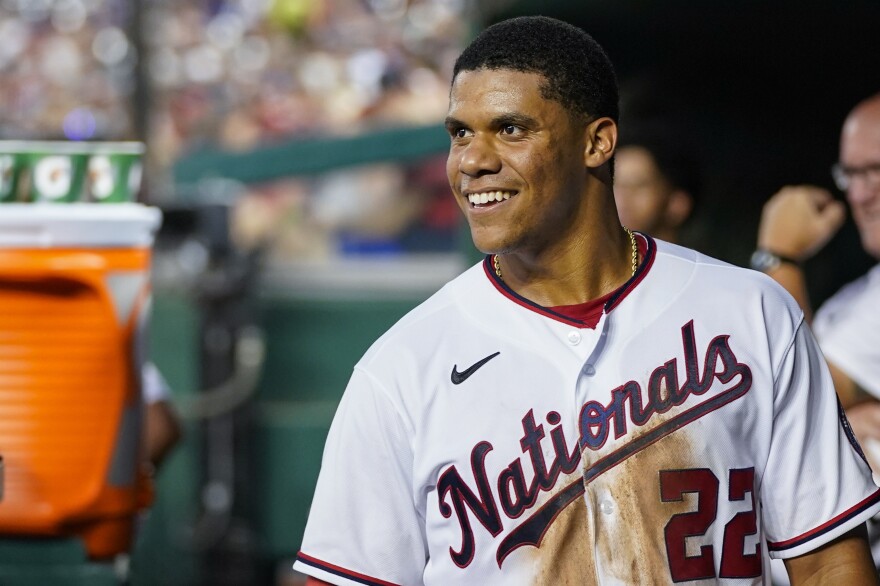
If you’re a longtime Washington Nationals fan then you must be frustrated with them for mastering the art of false hope. Four years ago, they made what looked like the ultimate heist. Juan Soto, superstar outfielder in his prime, nets the Nats a return package that included MacKenzie Gore, a legitimately talented young left-hander drafted third overall. Shortstop CJ Abrams. James Wood, a talented outfielder with upside. It felt like the rare trade where everybody wins — San Diego gets its franchise cornerstone, and Washington gets to retool with young, controllable talent.
Then the Nationals lost 96 games last season. And before that? 91. And before that? 91 again.
So new Nationals president of baseball operations Paul Toboni did what any sane front-office executive would do and traded MacKenzie Gore to the Texas Rangers for five prospects, including shortstop Gavin Fien, the 12th overall pick in last year’s draft. Toboni’s message was clear, unapologetic, and actually quite blunt, We lost 96 games last year, he told reporters. To turn it around in one year and make the playoffs — not to say it can’t be done — but it’s a challenge. What we want to do is make sure we build this really strong foundation, so when we do start to push chips in, we can win for an extended period of time.
He was essentially saying that they’re going to be worse before being get better. And didn’t want to find that out after betting on Gore. The Gore trade is the right call for all the wrong reasons, and the wrong call that happens to be right.
Gore’s 2025 season was Jekyll-and-Hyde. He made his first All-Star team with a strong first half, then limped through the second half of the year. His final numbers — 4.17 ERA, 1.35 WHIP over 30 starts and 159⅔ innings — are the numbers of a solid fourth starter, not a franchise cornerstone. More problematically, he struggles with command. His 3.6 walks per nine innings ranked among the bottom six among qualified pitchers. For a young guy who was supposed to be the centerpiece of a rebuilding rotation, that’s a red flag the size of the Washington Monument.
He’s also remarkably tradeable. Gore is under team control through 2027, making just $5.6 million this year. That’s the sweet spot for a contending team: young enough to project forward, inexpensive enough to fit the budget, talented enough to move the needle. The Rangers clearly thought so. They surrendered five prospects for him, including a top-12 draft pick. That’s real capital. If the Nationals hold onto Gore and he posts another 4.17 ERA in 2026, they get nothing for him. He walks into free agency as a 27-year-old with mediocre numbers and command issues. They’d be stuck.
By trading him now, Toboni essentially accepted reality which is the Nationals aren’t close enough to playoff contention to justify betting on a guy’s potential. Better to grab five young players and hope one or two of them actually become something in five or six years.
Here’s where this gets genuinely icky. The Collective Bargaining Agreement expires December 1, 2026. The owners are already making noise about implementing a salary cap — they’re raging about Kyle Tucker’s four-year, $240-million deal with the Dodgers and Edwin Diaz’s three-year, $69-million contract. There’s a very real possibility that we’re headed for another lockout, potentially one that could cost the 2027 season entirely. The last time owners and players locked horns was during the 2021-22 offseason, and that nearly killed Opening Day. This time feels different. This time feels urgent.
So why would the Nationals trade away one of their best young arms right before a potential work stoppage that could freeze the entire offseason next winter? If a lockout wipes out the 2027 season, the minors continue to operate. The Nationals can develop those five prospects. But Gore, already in the majors, either sits around collecting dust or gets called up to a team that’s not competitive anyway. It’s the ultimate hedge.
Is it a cowards move? Maybe. Is it smart? Also maybe. Toboni is that the Nationals don’t know what the landscape looks like in December 2026. So cashing in Gore now while the Rangers and the rest of baseball are still operating like normal makes the most sense for them.
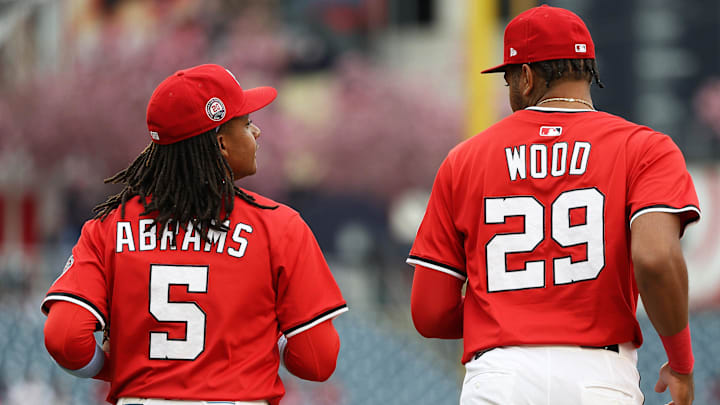
The Gore trade isn’t really about Gore. It’s about the Nationals admitting they failed. James Wood is still promising. CJ Abrams is still promising. But promising isn’t enough when you’ve lost 91, 91, and 96 games in three consecutive seasons. The Juan Soto trade return didn’t work. The front office that built this roster didn’t work. Dave Martinez as manager didn’t work. Mike Rizzo as general manager didn’t work.
So now Toboni and new manager Blake Butera — the youngest manager in baseball since 1972 — get to start from scratch. Again. They get to develop prospects in the minor leagues for a few years and draft well. Then in 2028 or 2029, we’ll push chips in with a real foundation.
It’s the right approach if you’re willing to lose another 85-plus games this year and probably the year after. It’s the right approach if you can stomach that.
Here’s the thing, folks: This is a gut punch to anyone who believed that Juan Soto haul four years ago was going to salvage this franchise. Gore was supposed to be the ace. Instead, he’s the casualty of organizational dysfunction.
With that… This is what happens when you lose 96 games.
If you cannot play with them, then root for them!