
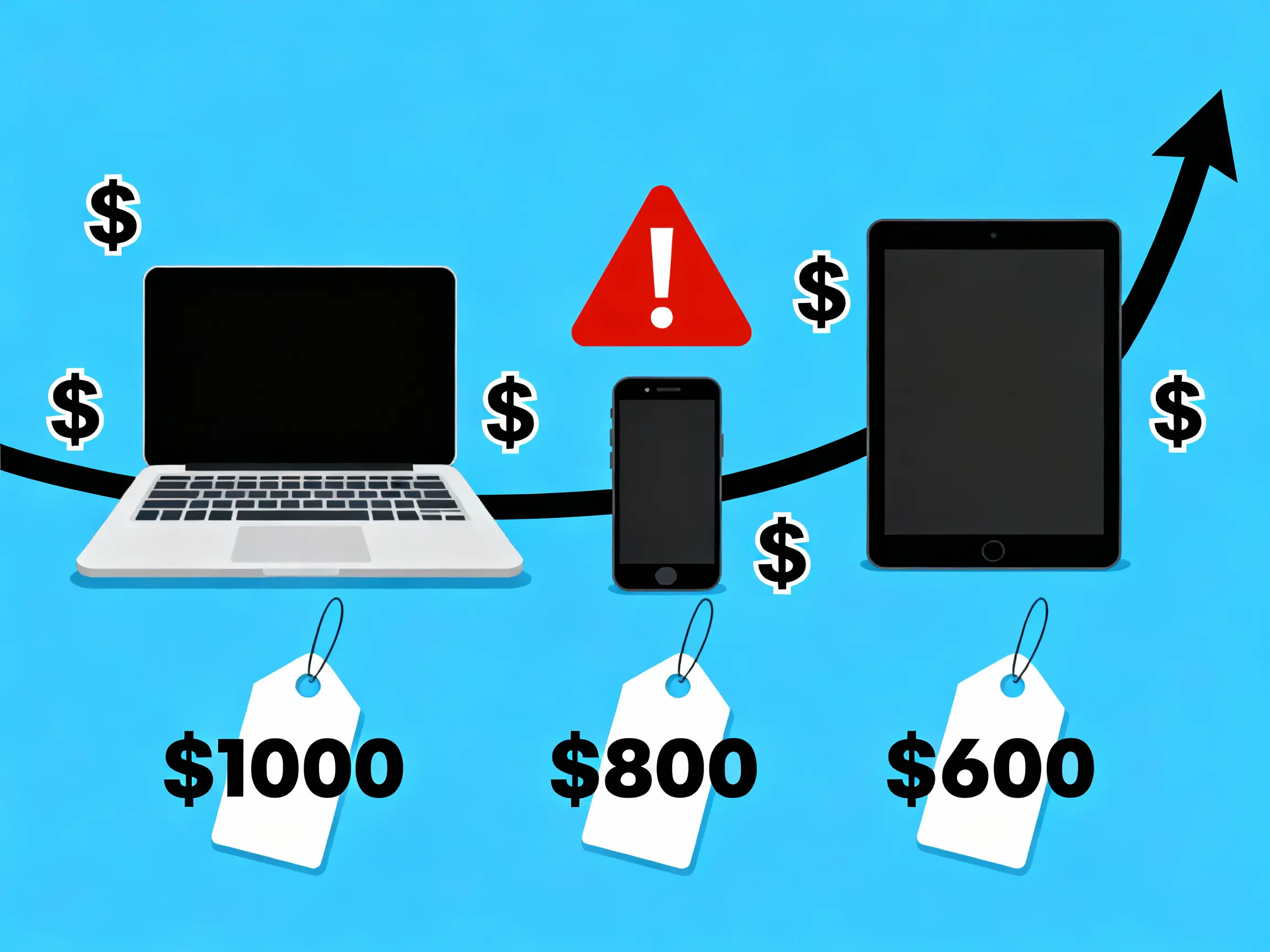
If you’ve been eyeing a new laptop, smartphone, or tablet and thinking you’ll wait until next year to pull the trigger, you might want to reconsider that strategy. Word on the street is that the gadgets we rely on daily are about to get significantly pricier, and contrary to what you might have heard, the AI boom isn’t really the culprit here. The real story is a lot more complicated and involves something far less exciting than artificial intelligence: tariffs.
Now, I know tariffs aren’t exactly the most thrilling conversation topic, but stick with me here because this is going to hit your wallet hard. The Consumer Technology Association has been sounding the alarm bells pretty loudly, projecting that laptop and tablet prices could jump by anywhere from 46% to 68% depending on which tariff scenario plays out, according to research published around. We’re talking about an average increase of $250 to $357 per laptop, and that’s not chump change for most of us.
The Trump administration has been implementing what they call reciprocal tariffs throughout 2025, with rates on Chinese imports climbing as high as 145% on certain electronics categories. And here’s the kicker: while there were some temporary exemptions announced for smartphones, laptops, and semiconductors earlier this year, Commerce Secretary Howard Lutnick made it crystal clear that nobody’s getting off the hook permanently. These exemptions are just that, temporary, and the administration has been preparing what they’re calling semiconductor tariffs that will sweep these products back into the taxable category.
The complicated web of these trade policies means that roughly 87% of game consoles come from China, making them particularly vulnerable to price hikes, with projections showing potential increases of up to $428 per unit. Smartphones aren’t faring much better, with estimates suggesting price jumps between 26% and 37%, which could translate to an additional $213 on your next phone purchase. Even desktop computers and monitors are expected to see increases, with monitors potentially costing $111 more on average.
What makes this situation particularly frustrating is that it’s not like manufacturers can just flip a switch and start making everything domestically. The Consumer Technology Association’s research points out that about 79% of all laptop and tablet products currently come from China, and even if domestic production ramped up, it would only increase by an estimated 8%. Moving that kind of manufacturing capacity to other countries would be problematic, especially in the short term, as trade experts have noted.
The ripple effects are already being felt across the electronics supply chain. Companies are seeing input costs rise by 18% to 25%, particularly for printed circuit boards, memory chips, and processors sourced from China. And here’s where it gets even more complicated: even when goods aren’t directly labeled as Chinese origin, the U.S. imports an additional $50 to $60 billion of electronics-related inputs from countries like Malaysia, Vietnam, and Taiwan, which themselves source significant subcomponents from China. So these tariffs create what researchers are calling systemic inflationary pressure that’s nearly impossible to escape.
The political calculus behind these tariffs revolves around trying to stimulate domestic manufacturing and address long-standing concerns about intellectual property and trade imbalances with China. The Trump administration has framed this as a national security issue, with tariffs ranging from 10% on all imports coupled with an additional 60% to 100% specifically on Chinese goods, depending on which policy scenario ultimately takes hold. There’s even talk of tariffs being calculated based on the number of chips in each device, which would affect everything from toothbrushes to laptops.
What’s particularly concerning for consumers is that the Consumer Technology Association estimates these tariffs could reduce U.S. consumer spending by a staggering $123 billion annually, with overall economic output shrinking by $69 billion. We’re not just talking about paying more for gadgets; we’re talking about fundamentally changing buying behavior. The research suggests that consumers would decrease their purchases of laptops and tablets by 54%, smartphones by 44%, and video game consoles by 57% in response to these price hikes.
Now, you might have read some headlines about the AI boom causing memory chip shortages and driving up prices, and there’s definitely some truth to that story. AI servers do consume massive amounts of high-bandwidth memory, and suppliers are prioritizing that more lucrative market. But when you look at the magnitude of the projected price increases we’re facing in 2026, tariffs are doing the heavy lifting on the cost side, not AI-related supply constraints. The tariff-driven increases we’re talking about dwarf the incremental costs from memory chip pressures.
The timing of all this couldn’t be worse for discretionary consumer spending. PitchBook research shared with industry publications notes that electronics, along with apparel and sporting goods, face elevated risk from the current tariff environment. The combination of higher prices and economic uncertainty is expected to slow not just consumer purchases but also venture capital and private equity activity in the tech sector.finance.
Here’s the thing, folks: Big retailers like Amazon, Walmart, and Costco might actually benefit from this situation because they have the operational efficiency and scale to weather the storm better than smaller merchants. But for the average consumer trying to upgrade their aging laptop or replace a cracked phone screen, 2026 is shaping up to be an expensive year. The average selling price for smartphones is expected to climb to $465 in 2026, compared to $457 in 2025, pushing the smartphone market to a record high value of $578.9 billion.
With that… The bottom line is if you’ve been putting off that tech purchase, you might want to seriously consider making your move before these tariff policies fully take effect. The temporary exemptions that have been in place are just that, temporary, and once the full tariff regime kicks in throughout 2026, we’re looking at price increases that will fundamentally change what consumers can afford. Whether you agree with the policy rationale or not, your next phone, tablet, or computer is almost certainly going to cost you more next year, and you can thank tariffs, not AI, for that unwelcome reality.
You do not have to be a practicing politician to have an understanding of political topics.