
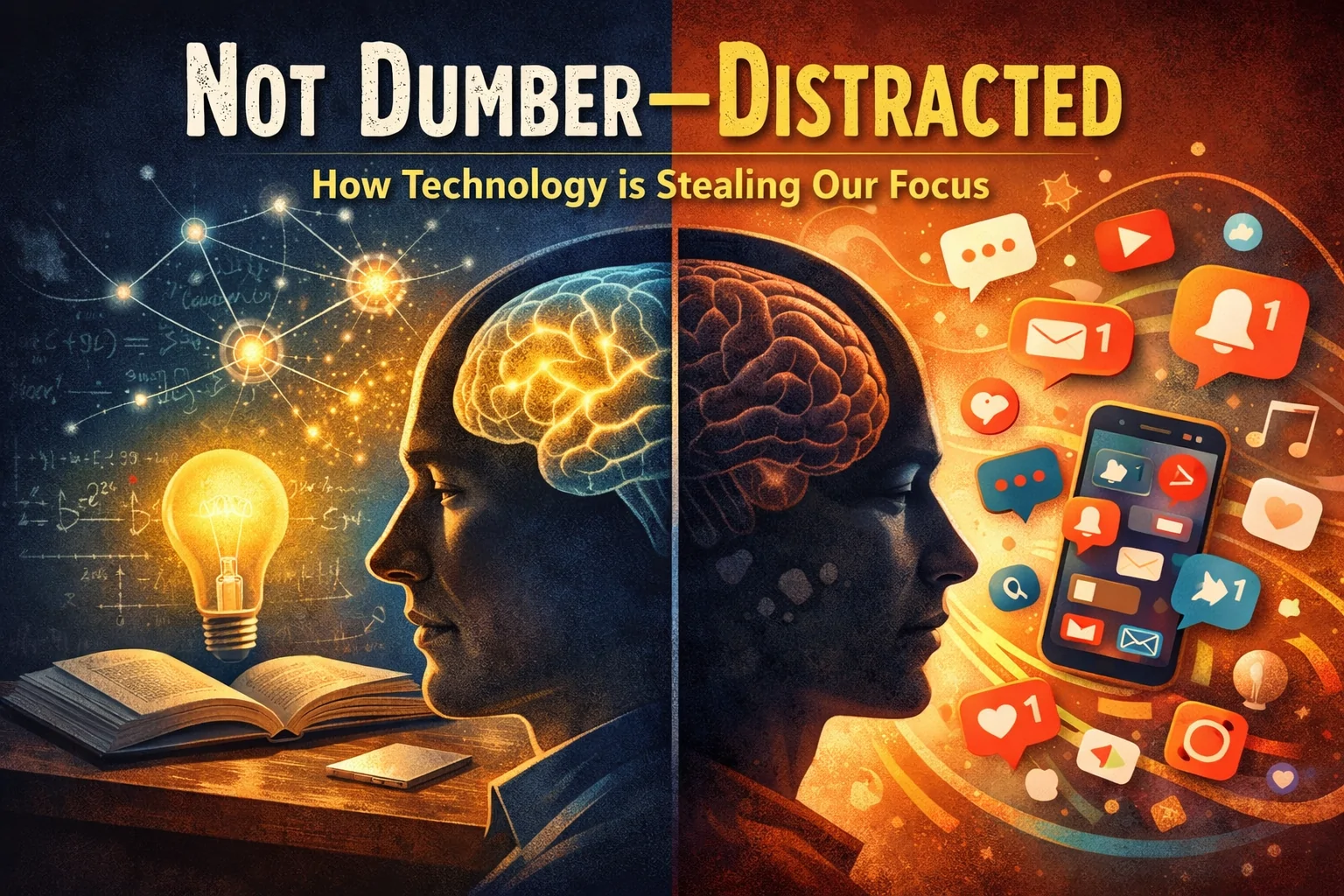
In the last few days, I came across this article by Joshua Rothman who writes for The New Yorker. He shares his thoughts about how and why people are getting stupider. However, I think what comes off as stupidity is simply us being distracted and/or forgetful. So, todays Binary Response is entire response to his article. Please sign up to get our Binary Response articles directly in your inbox!
Let’s start with a confession: I had to reread The New Yorker’s “Are We Getting Stupider?” three times before I could actually focus on it long enough to form an opinion. Not because it was boring — it’s thoughtful and well written — but because I was reading it while doing other tasks the first two times. That, right there, might be the point.
We’re not necessarily getting stupider, but we’re absolutely getting more distracted. And distraction can look an awful lot like stupidity when you can’t focus long enough to finish a paragraph, remember what tab you were on, or figure out why you walked into a room.
Joshua’s piece dives into the so-called “reverse Flynn effect” — the finding that after decades of rising IQ scores in the 20th century, the trend has started to decline in parts of the world. Researchers can’t quite agree on why. Some say education standards slipped. Others blame environmental factors or politics. But I’d argue one of the biggest culprits is literally sitting in the palm of our hands.
Smartphones have rewired how our brains process to prioritize information. They’ve turned what used to be moments of quiet observation— waiting in line, sitting in traffic, sipping coffee — into micro-bursts of stimulus. Instead of letting our minds wander, which is a crucial piece of creative and critical thinking, we scroll. And scroll. And scroll some more. It’s not that the tools made us dumb. It’s that our constant need to check them trains our brains to crave interruption. We used to call lack of attention “daydreaming.” Now, it’s “doomscrolling.”
The other big brain drain is convenience. Twenty years ago, people prided themselves on remembering phone numbers, directions, birthdays, and the names of random character actors from old sitcoms. Today, we don’t have to remember anything because our devices, browsers, and AI chatbots will do it for us. Can’t recall who invented the lightbulb? Ask ChatGPT. Need a recipe but forgot the ingredients halfway through? Gemini or Perplexity can fill in the gaps. Can’t remember your childhood zip code? Your iPhone probably does.
I’m not anti-AI — it’s incredible technology that’s transforming how we write, research, and work. But there’s a psychological tradeoff: when we know a system will remember for us, we stop remembering for ourselves. A generation ago, people used what psychologists called rote memorization. They could recite long strings of facts and instructions because their brains conditioned for it. Now we’ve created what I’d call outsourced recall. We’re delegating memory to machines. It’s efficient, but it also means the cognitive muscle we once kept sharp is turning to mush.
The paradox of our time is that we have more access to knowledge than any generation before us, yet struggle more to use it wisely. The collective intelligence of the internet is infinite, but our ability to apply that knowledge thoughtfully is shrinking. This isn’t because people are lazy — it’s because our brains weren’t built for this level of input. The average American now consumes more than thirty-four gigabytes of data per day, equivalent to reading over 100,000 words daily — most of it fragmented across endless feeds, threads, and notifications. So when people misspell simple words, overlook obvious math errors, or fall for clickbait headlines, it’s not because they’ve lost basic intelligence. It’s because they’re operating under constant cognitive overload.
The scariest part isn’t that we might be forgetting facts — it’s that we’re forgetting how to think. AI tools like ChatGPT, Grok, Gemini, and Perplexity are changing how we process and approach questions. Instead of engaging in slow, thoughtful reasoning, we delegate our mental effort to software. The result can be impressive and fast, but it’s also hollow if we stop engaging critically. The average person now uses AI to summarize long articles, write work emails, or explain complex topics they don’t truly understand. In many cases this is creating an illusion of mastery — like being fluent in a language only as long as Google Translate is open.
When that illusion becomes normal, real curiosity starts to fade. Why wrestle with a concept when an algorithm can produce an answer in seconds? That kind of mental laziness doesn’t happen overnight — it creeps in as we get comfortable not needing to think deeply.
It is hopeful to think that this isn’t irreversible. We can retrain ourselves to focus and think more deeply, but it takes intention. For every shortcut technology gives us, we need to rebuild habits that keep us mentally active. Maybe it’s as simple as writing notes by hand instead of dictating them, sitting with a question before Googling it, or turning off notifications for an afternoon. The goal isn’t to reject technology — it’s to reclaim ownership of our attention.
Here’s the thing, folks: We may not be getting stupider, but if we don’t control how we use our tools, we’ll lose the sharpness that made progress possible in the first place. Technology has given us incredible power and freedom, but power works both ways — it can sharpen or dull, enhance or erode.
With that… Maybe intelligence isn’t declining so much as diffusing. We’ve spread our attention so thin that brilliance gets lost in the noise. The challenge of our time isn’t just learning new things — it’s remembering what we once knew, and giving our minds the silence to rediscover it. This isn’t an argument against innovation. It’s a reminder that the smartest era in history will only stay smart if we keep exercising our minds the old-fashioned way — by thinking for ourselves.
When the technology is there sometimes we just need to be careful how we
Thanks for reading Binary Response! Subscribe for free to receive new posts and support my work.