
I’m a bit more bleary-eyed than usual this morning, and it’s not strictly due to the heat wave and my relentless migraines. We’ve just ended a week where 104 significant post-season college basketball games were compressed into six days. Unlike a couple of my far more addicted friends, I didn’t watch every one of them, even in the condensed form they are evangelizing to me about that has at least allowed them to get through with watching the tournament before Independence Day.
But I’m at least up to speed with what’s transpired, and the good news we’ve made it through the most challenging stretch–while we’re only at the one-third mark in terms of schedule, we’ve past the three-quarters mark in terms of games. And I was fortunate enough to be able to watch live a few of the more memorable ones.
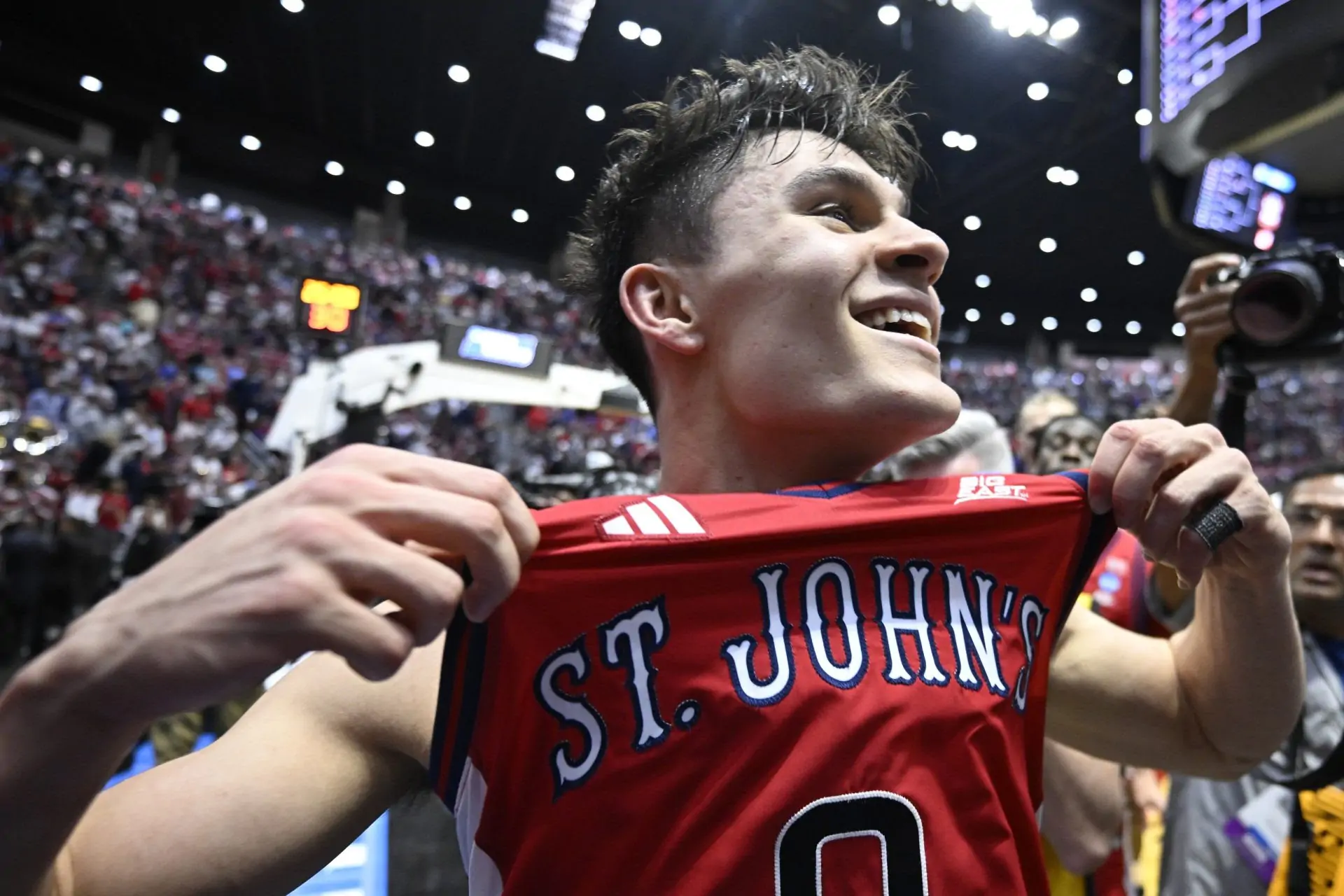
For this Queens native, probably the most satisfying was the amazing way the borough’s sole Division I one program brought back glory days that I remember ever so fondly, as FRONT OFFICE SPORTS’ MEMO newsletter recapped:
On Sunday, No. 5 St. John’s knocked out Bill Self’s storied Kansas program with a buzzer-beater. The Red Storm are experiencing a resurrection of sorts; led by Rick Pitino, the Red Storm have secured their first Sweet 16 berth since 1999. While St. John’s is a member of the Big East, a much less wealthy conference than those of the Power 4, its storied basketball history is widely considered an additional power conference in men’s basketball.
St. John’s men’s basketball budget isn’t publicly available, but its NIL and revenue-sharing is renowned for being among the highest in the Big East at about $10 million. The Red Storm are backed by billionaire alum Mike Repole, a benefactor often referred to as a “co-owner” of the program who has now engaged in multiple campaigns to match donations to the program.
And as ESPN’s Myron Medcalf detailed this morning, Repole and company’s ROI is looking particularly brilliant of late:
Rick Pitino has coached in the NBA twice. He has dealt with scandals at multiple programs. He has coached overseas. Now, after returning to college basketball a few years ago, he’s the king of New York. Because he has led St. John’s to the Sweet 16 for the first time since 1999. It’s the fourth program he has taken to the second weekend of the NCAA tournament. But this particular team didn’t do it with finesse. St. John’s shot 51% from inside the arc (218th nationally) and 33% from beyond (192nd nationally) this season. But none of that showed up Sunday against Kansas. Other than a boost from Bryce Hopkins (an unexpected 6-for-9 outing from the 3-point line after making 31% of those shots this season entering the game), the Red Storm beat Kansas with a tenacious defense (18 points off 16 Kansas turnovers) and by outlasting their opponent. Right down to Dylan Darling‘s winning layup at the buzzer. St. John’s has lost only one game since Jan. 3 because it just refuses to break in the most significant moments.
My own personal intrigue aside, the even bigger story so far naturally resides where things are much, much bigger by nature, as the FOSers further elucidated:
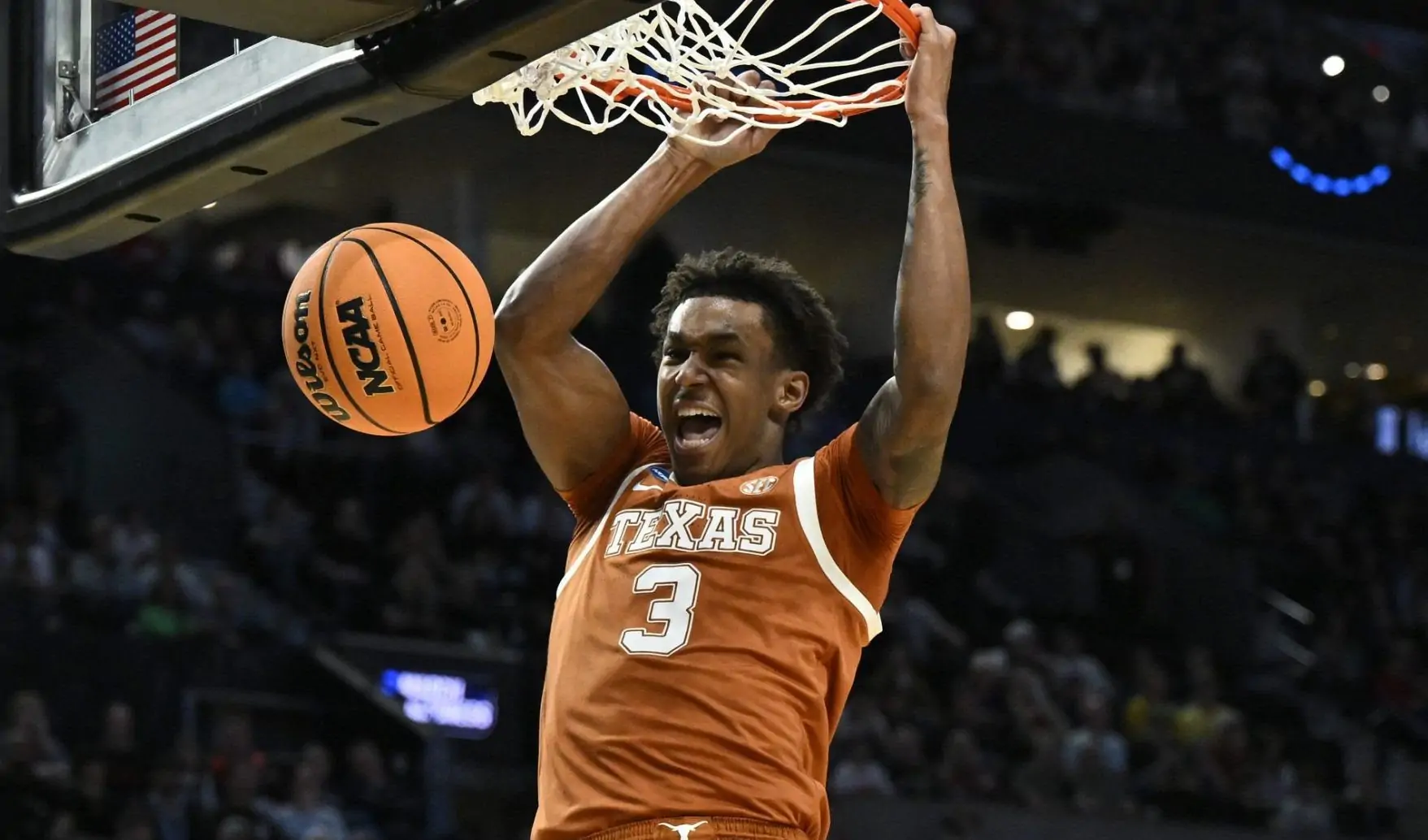 An “underdog” 11-seed Texas knocked off No. 6 BYU and No. 3 Gonzaga…The lowest-seeded program to make the Sweet 16 is the Longhorns, for example, who have made it from the First Four to the Sweet 16. During the Round of 64, Texas bested a powerhouse No. 6 BYU program led by potential top NBA Draft pick AJ Dybantsa.
Then, in the Round of 32, the Longhorns took down No. 3 Gonzaga. It was a bizarro-world scenario in which the Zags, despite being a mid-major, had plenty of storied history in the men’s tournament and were very much favorites, while the wealthy Longhorns were the plucky underdogs.
But they can’t be considered Cinderellas given their plethora of financial resources, and many have protested labeling them underdogs at all, despite their double-digit seed. The Longhorns are part of one of the richest conferences in all of college sports. In 2024-25, Texas boasted a men’s basketball operating budget of $22.4 million—the fourth-highest in all of men’s college basketball, according to data obtained by Extra Points. That doesn’t include revenue-sharing and NIL money.
And to underscore the point further, the other thriller from yesterday’s slate took the wind out of another friend’s sails in a most painful way, again per FOS and Medcalf:
 On Sunday night, No. 9 Iowa beat No. 1 Florida with a three-pointer in the final seconds of regulation for a 73-72 win…The Hawkeyes were 3-7 in their previous 10 games entering the NCAA tournament. During that stretch, they were sub-50 in offensive and defensive efficiency, per BartTorvik, and had shot 31% from 3…It’s clear now that Iowa’s late slip was just a blip. Remember, before that monthlong slide, the Hawkeyes were top 25 in offensive and defensive efficiency in coach Ben McCollum’s first season… They were a good team. And then, weeks later, Alvaro Folgueiras made the winning 3-pointer in the upset of 1-seed and defending champion Florida. And just like that, the Hawkeyes are winning again.
But they are among a mere handful of games that actually were worth the watch on the men’s side. The ladies so far have pretty much the antithesis of compelling. As CBS SPORTS’ Jack Maloney and Isabel Gonzalez noted on Saturday:
Ultimately, every higher seed advanced. It was a day full of chalk…Upsets are pretty rare in the women’s NCAA Tournament, in part because the top four seeds get to play their first-weekend games on their home courts.
That reinforced a view that was amplified by SPORTS ILLUSTRATED’s Todd Golden roughly a year ago:
Neutral sites aren’t used in the women’s basketball tournament until the Sweet 16 round. It has been that way since 1994, when the women’s tournament first became a 64-team affair. For years, women’s basketball observers have advocated for the women’s tournament to take the lead of the men’s tournament and play at neutral sites in the first and second rounds.
Indiana women’s basketball coach Teri Moren has been on both sides of the coin. This was the first time Indiana went on the road since 2019…Moren seemed cognizant of the chutzpah of advocating for neutral site games – just one year 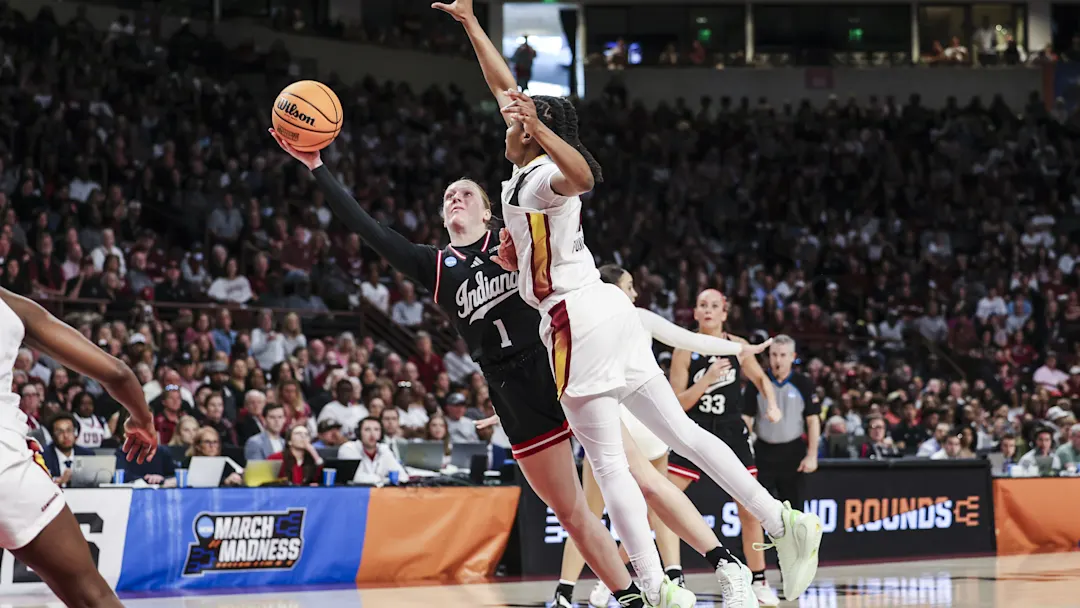 removed from having hosted three seasons in a row…“I think we’ve got to get to a point where we sort of mirror what the guys do and have those neutral sites, because matchups matter, but home-court advantage matters,” Moren continued. “Again, I’ve been a recipient. I’ve been on the other side of this where our players have had to come in, players have had to come into Simon Skjodt Assembly Hall and play in such a daunting place with our fans.”
As if to prove Moren correct, here’s how Medcalf’s colleague David Wilson covered how the women’s version of “non-Cinderella” proved to be thoroughly unentertaining–and for me upsetting–yesterday afternoon:
1) Texas 100, (8) Oregon 58
The Longhorns let Madison Booker do her thing. The junior scored a career-high 40 points, a Texas NCAA tournament record, grabbing eight rebounds and adding five assists and two steals, powering the Longhorns to just their third 100-point game in NCAA tournament history (last year vs. William & Mary and once in 1986). Booker and point guard Rori Harmon tormented the Ducks from the start, with Harmon adding nine points, six assists and five steals, forcing Oregon’s offense to labor all night…The combo of Harmon and Booker can take Texas as far as it wants, combining to score or assist on 64 of Texas’ 100 points, more than Oregon’s 58 for the entire game. Texas’ relentless defense forced 15 turnovers and held Oregon to just eight points in the third quarter.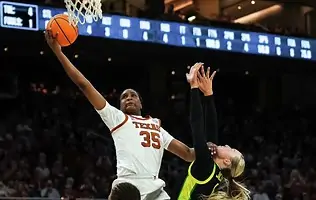
The only thing bigger than financial disparity in Texas is the chasm that exists between the top-tier and next-level women’s teams. The Longhorns could have played this game at a rec center in Queens and probably have achieved a similar result. I mean, look what that’s done for the Red Storm and me, right?
Courage…