
There’s no question a professional sports league needs to give its players at least a little time off during a grueling season, and rewarding its best with a little accolade and a chance to shine in a showcase doesn’t hurt their bottom line or brand, either. The problem has been that increasingly a traditional All-Star game simply matters less and less to just about everyone except the most hard-core fans and its participants, and that’s been no more evident than in the case of the National Hockey League.
In recent years, the league has created a so-called “mini-tournament” that originally compiled teams from each of its four eight-team divisions (good on you if you can name them without Googling it) and had two each square off in eliminations that were limited to one 20-minute period apiece, with the winners facing off in the “finals” , a.k.a. the third period. The scores were ridiculously inflated; the 2023 game produced a total of 38 goals in 60 minutes. Last year the format borrowed a page from the NBA and created teams named for what they’d like to believe are four of its top stars, with hometown hero Auston Matthews of the hosting Toronto Maple Leafs leading his team to a championship where the aggregate goal count was “down” to 29. Again, good on you if you can pick him out of a police lineup.
So in search of yet anothe variation, the league has scrapped the ASG for at least this year and replaced it with something they call the 4 Nations Face-Off, which begins tonight in Montreal where homestanding Canada will be tested by a squad representing Finland. The United States will wait until tomorrow night to begin their play against Sweden. THE ATHLETIC’s Sean Gentile attempted to shine some clarity on what exactly it is and why it should matter:
Connor McDavid knows what you might be thinking about the 4 Nations Face-Off, the best-on-best international tournament featuring NHL players that begins on Wednesday.
“Yes, it’s not the Olympics. I understand that,” McDavid told reporters on Feb. 2. “It’s not a World Cup of Hockey, but there is still something on the line and we want to represent our country well.”
It’s simple enough: NHL rules, but a modified points system. Each team will play once, round-robin style. Regulation winners will receive three points; overtime/shootout winners will receive two points; overtime/shootout losers will receive one point; regulation losers will receive zero points. At the end of the six-game round-robin schedule, the two teams with the most points will meet in the championship game. For round-robin games, overtime will be held in a 10-minute, three-on-three sudden-death period, followed by a three-round shootout. In the final, full 20-minute, five-on-five periods will be played until a goal is scored.
MLIVE’s Tyler Kuehl’s preview dropped earlier today shines a brighter light on why these games might be worth watching:
(N)umerous big-time stars in the NHL and beyond will meet in the first international tournament with the NHL’s involvement since the 2016 World Cup of Hockey.
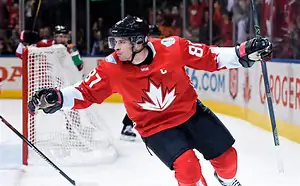 The winner of that tournament was Canada, though the roster looks a lot different. Though captain Sidney Crosby and Brad Marchand remain from that gold-medal-winning team, there are several young stars looking to make an impact in the tournament. That includes Edmonton Oilers…McDavid, who was on the magical Team North America squad in 2016. Sweden also has a talented roster. Led by the veteran Victor Hedman, they have several game-changers who are capable of contending for the championship. With William Nylander leading an offensive united featuring Filip Forsberg and Mika Zibanejad, Tre Kronor cannot be taken lightly over the next week.
But for as exciting as that may all sound, this is an incomplete amalgram of star power. Gentile explains that there are myriad of reasons for this effort being limited to four–er 4–nations–some logistical, some political.
This tournament is an NHL/NHLPA creation, designed to replace the All-Star Game and offer fans (and players) a taste of best-on-best international hockey before the 2026 Olympics. More teams would mean more games, a longer break in the NHL schedule and extra logistical headaches. Not ideal.
Beyond that, countries like Czechia, Slovakia, Germany and Switzerland would need a fair amount of non-NHL players to fill out their rosters, and the IIHF isn’t involved in any official capacity. There’s no real benefit to European teams allowing their best players to go on leave for an NHL moneymaking venture.
When it comes to Russia, the NHL is taking its cues from the IIHF; the federation has banned Russian teams due to the country’s ongoing war in Ukraine.
So not only does that mean that there’s no Alex Ovechkin; there’s no David Pastrnak, no Anze Kopitar, no Timo Meier, no Leon Draisaitl. Big names from big hockey markets making significant contributions to their teams and worthy of some sort of mid-season showcasing. But this year, they’re reduced to cheerleaders.
I’ll admit I’m a tad more curious than I otherwise would have been for a traditional game, and the fact that this is being extended out over eight days with games exclusively in prime time will command that much more bandwidth than a Saturday afternoon counterbalance to football otherwise would. And this will serve as sort of a warm-up for the majority of these players for next year’s Olympics in Milan, where the NHL will make a triumphant return to after skipping 2022 in Beijing due to concerns about Covid. Those other countries and most of those aforementioned players will be returning. And if you are to believe the rhetoric coming out of Washington these days, there’s an outside chance that even Russia might be part of that by then, too.
Hey if they can get people to care about these games, anything’s possible, right?
Courage…