
Much like this year’s World Series itself, we eventually got the results we kinda expected, but the journey to get there was a lot more unpredictable and unexpected that we might have otherwise wagered (that’s for those of us who don’t pitch for the Cleveland Guardians)/
So the news that MLB.com’s Anthony Castrovince broke yesterday on a site that itself was part of the narrative was on the surface more of a confirmation of previous rumors and leaks than anything else:
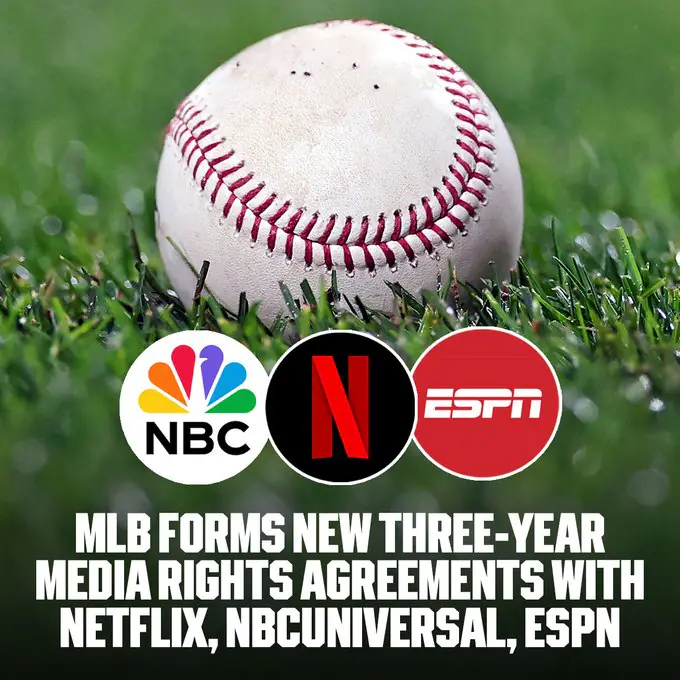
MLB announced Wednesday that it has formed new three-year media rights agreements with Netflix, NBCUniversal and ESPN.
As part of the rights agreements, which cover the 2026-2028 MLB seasons, the league’s longstanding relationship with ESPN will reach 39 consecutive seasons, NBC will return to regularly airing games on its broadcast network for the first time in a quarter century, and Netflix’s engagement with MLB will expand from documentaries to live baseball event coverage for the first time.
Sunday Night Baseball will shift from ESPN, where it aired since 1990, to NBCUniversal, which also secured the rights to Sunday Leadoff and the Wild Card Series in the postseason for NBC and Peacock. Netflix will now air the T-Mobile Home Run Derby, an Opening Night exclusive and special event games set to include the 2026 MLB at Field of Dreams Game and the World Baseball Classic in Japan. And ESPN will receive a national midweek game package throughout the season while also acquiring the rights to sell MLB.TV, the league’s out-of-market streaming service that set a record with 19.4 billion minutes watched in 2025.
I’ve mused about those nuggets before, especially the part about NBC getting back more significantly into baseball that they’ve been at any other point this century. Yes, they actually had Sunday Leadoff for a coupla years (2021-22) and the fine folks at what was in the previous century an Emmy Award-winning mecca used much of the same formula that they have incorporated into their return to the NBA this fall–a fawning respect and frequent shout out to the generation that remembers it, such as the use of iconic themes from the past and the restoration of a policy of including a guest play-by-play announcer from the staff of the home team, which to me brings back warm fuzzies of Lindsay Nelson, Bob Prince and Al Michaels getting national audiences for what turned out to be iconic World Series moments. No, an 11:35 am start for a Pirates-Nationals showdown in August isn’t quite as big a deal, but it’s a start.
The ESPN details did throw in a few new wrinkles, including the national midweek game that the network eschewed several years back, mostly because it was non-exclusive to regional sports networks which most hard-core local fans (me!) preferred and at times would force the ESPN feed to be blacked out on MVPDs in the home team’s DMA. Castrovince made a particular point in noting that is no longer the case. That’s essentially what they now have with NBA Wednesdays, and that doesn’t sit all that well with fans who consistently bitch about not knowing where they can find their team’s game. And it sure seems like a give to help mollify what was a nasty and almost exceptionally expensive spat that the ATHLETIC’s chief yenta Andrew Marchand devoted a wonderful recap to in his own reporting yesterday:
Major League Baseball commissioner Rob Manfred made a nearly $1 billion mistake. Manfred and top MLB executives were the ones who insisted on placing an opt-out in the final three years of its seven-year, near-$4 billion contract with ESPN. ESPN’s chairman Jimmy Pitaro and his team agreed to the opt-out clause but asked for their own. Manfred and MLB acquiesced. Then ESPN used it this February.
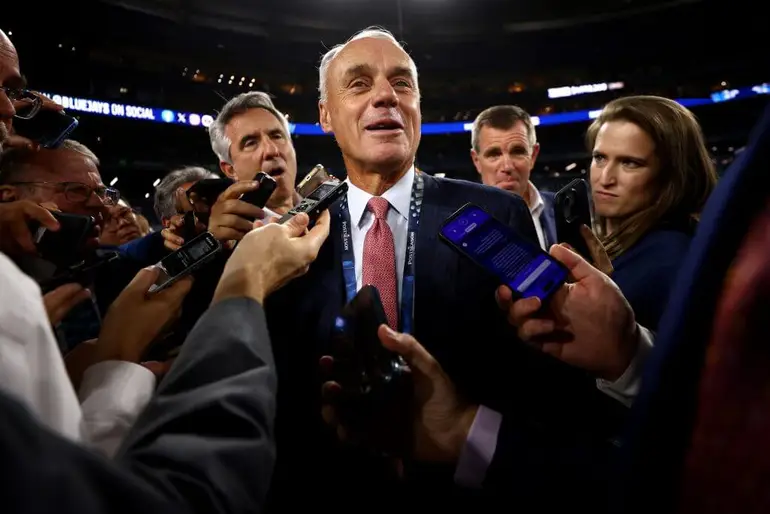 ESPN planned to pay around $1.65 billion over the next three seasons for “Sunday Night Baseball,” the Home Run Derby and first-round playoff games. Now, NBC/Peacock has picked up “Sunday Night Baseball” and the first-round playoff games for nearly $200M a year, while Netflix took on the Home Run Derby, Opening Day and the “Field of Dreams” game for $50 million per season. Those two deals add up to nearly $750 million in total over the next three years, which is $900 million less than what ESPN owed before the opt-out. Manfred’s move in the original negotiations is akin to reaching for a 3-0 pitch and fouling out instead of just taking first base and collecting $1.65B.
So hence the sport played a chip that the NHL had previously done and hand that business over to ESPN. Marchand describes how and when this lovers’ quarrel was eventually mediated:
By July, Manfred and Pitaro made up at Allen & Company’s Sun Valley conference in Idaho — as executives are wont to do — and eventually MLB ended up selling one of the league’s crown jewels, MLB.TV, to ESPN, its out-of-market streaming distribution platform; the rights to six teams’ local, in-market games; and 30 exclusive weekday regular season games. MLB recouped the $1.65 billion deal from ESPN, which will pay $550 million per year for three years for these rights. To twist a phrase, money heals all wounds.
Perhaps, but not necessarily the wound of confusing and frustrating fans as to where to find the damn game in the first place. Castrovince also made it a point to note that, at least for the time being, MLB Network will continue to be available to fans purchasing an MLB.TV subscription and will remain available to fans through linear packages and a standalone direct-to-consumer offering.
What he didn’t say is that folks like me who have had that package and ESPN+ found the same array of tile options for individual games on both in previous years. I remained loyal to MLB.tv because of its exceptional multiview option that fed as many as four live feeds at once to the same screen, additionally offering options for alternate audio and video feeds because, again, some hard-core fans freaking hate their opponents’ bland peeps that increasingly populate the remaining RSNs and even those MLB-empowered replacements that have sprung up in their place. ESPN’s offerings were strictly the home team’s video feed. I know how I’m leaning, but I would strongly encourage ESPN to catch up because I wouldn’t mind the potential cost savings.
Besides, ESPN clearly extracted a perk by getting exclusivity which incumbent TBS and their sister zombie networks still do not have with their Tuesday games. Oh, did we forget they’re not going away? Neither did Castrovince:
FOX/FS1 will continue to be the home of the All-Star Game and regular season games, as well as the World Series, League Championship Series and Division Series presented by Booking.com. TBS will continue to house LCS and Division Series telecasts, plus regular season games on Tuesday nights. Apple TV will continue to stream “Friday Night Baseball” doubleheaders throughout the regular season.
And yeah, I can already foresee yet another year of whining X-eets, Truths and Bluesky posts when Gary, Keith and Ron or Kruk and Kuik are nowhere to be found on some random mid-summer Friday night. You wouldn’t believe how hard-core fans overreact when you ask them to actually have to think twice about where to click to veg out.
Unless, of course, you’re also one of them that are excited that so many different media entities still value baseball as an investment with enough scale and a long enough season to still throw money at it, despite the likes of what Marchard mockingly referenced accordingly:
When ESPN announced its opt-out in February, Manfred said MLB was opting out, too. It was kind of like some teenage-angst approach, “You are breaking up with me! Well, I’m breaking up with you!” Next, like a scorned lover scribbling a mean message in a yearbook, Manfred sent a memo to the league’s owners calling ESPN a “shrinking” platform.
Well, they’ve resolved their differences, like it or not. Let that be a guidepost to those of you already planning to inflict your personal hubris of confusion down the road. And, for heaven’s sake, at least for now take the win.
Courage…