
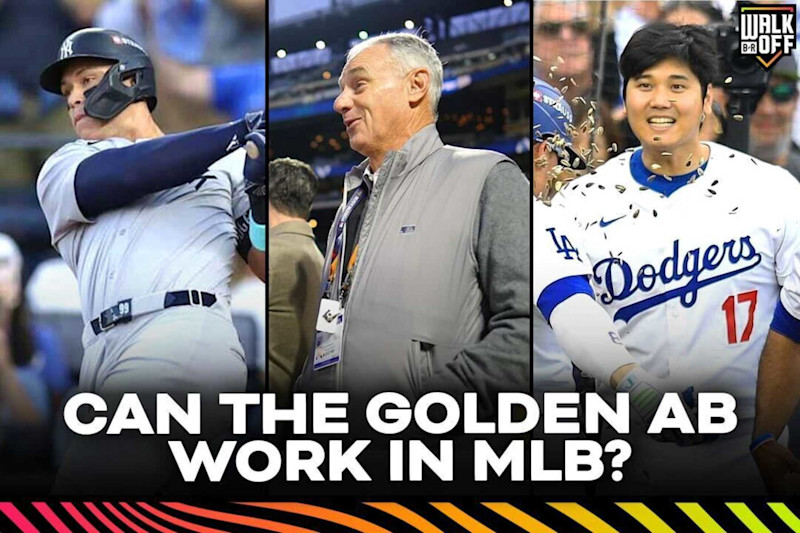
I know what it says on my driver’s license, and I know more than a few of you do as well. So by all demographic and psychographic inferences I suppose I should be in lockstep with those that have been clutching pearls ever since MLB commish Rob Mandred dropped this little nugget as described earlier this week by YARDBARKER’s Adam Gretz:
(O)ne idea that has been discussed and kicked around in recent months would be one of the most dramatic changes ever and completely change the very nature of the way the game has been played for more than 150 years. It is the golden at-bat, and it is something that…Manfred casually mentioned this week on John Ourand’s podcast.
 “There are a variety of (rule change ideas) that are being talked about out there,” Manfred said. “One of them — there was a little buzz around it at an owners’ meeting — was the idea of a “Golden At-Bat.”
The concept of the “Golden At-Bat” is simple enough — one time per game a team could choose any hitter in its lineup, whether it is their turn to hit or net, and send them up to the plate for an at-bat.
Gretz was quick to throw cold water on it in the later portions of his piece:
(I)t is a gimmick that has no place in real, competitive baseball games at the highest level of the sport.
Yeah, it would create some additional drama. But it would also rob the game of some of its greatest, most magical and most unexpected moments. Bucky Dent’s home run against the Boston Red Sox does not exist in a game or league where the New York Yankees could simply say, “Hey, Reggie Jackson, go hit again even though it is not your turn in the lineup.” .
But that’s nothing compared to some of the outcry that was coming out of New York, as dutifully reported yesterday by THE NEW YORK POST’s Erich Richter:
The Post’s Mike Vaccaro wrote Wednesday that the idea is “idiotic, imbecilic and utterly moronic.”
Former WFAN host Mike Francesa said he would refuse to watch baseball again if this “Golden At-Bat” rule was to be instituted by MLB.
And across the country, even in the calmer and somewhat warmer climes the reaction from the older purists that I fall closer in line to demographically were just as outraged, as SPORTS ILLUSTRATED’s Michael Brauner reported yesterday:
San Francisco Giants former right-handed starting pitcher and current television broadcast color analyst Mike Krukow blasted the proposed ‘Golden At-Bat’ rule change that has made headlines this week.
Krukow hopped on KNBR-AM/FM’s “Murph and Markus” morning show this week and when he was asked about it by the hosts, he let it be known that he is not for it at all.
“We’re seriously not going to talk about the ‘Golden Bat,’ are we?” Krukow groaned. “Five years from now, we’ll be playing slow-pitch softball. That’s where we’re heading…Baseball is such a beautiful game. Why are you messing with it?…I just think it’s absurd.”
And as several others including FOR THE WIN’s Andrew Joseph unearthed yesterday, apparently even Manfred himself at one point considered this idea abhorrent:
In an unearthed video from a 2015 Dan Le Batard Show interview, Jon “Stugotz” Weiner pitched the very idea of the Golden At-Bat to Manfred, calling it a “Magic At-Bat.” Instead of once per game, Stugotz wanted managers to be able to use it four (or five) times. Manfred said:
“I’m with your friend. You’re wasting my time. It’s a crazy idea.”
And at the time, Manfred added that he wouldn’t want to implement a rule that interfered with the history and traditions of the game. He explicitly said that the suggestion would fall into that category. So, what changed now? That should be a question every reporter asks Manfred as MLB looks more into the rule.
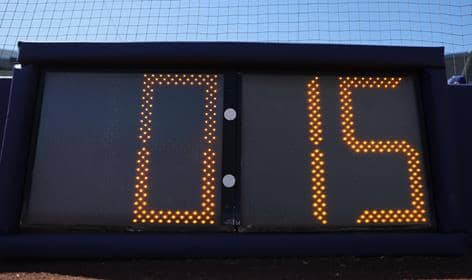 Manfred can point to recent implementations that originally got a lot of blowback as being successful in having a positive impact. The ghost runner rule, the increase in the size of the bases and the implementation of the pitch clock have brought down the length of an average game, per Statista, from a 21st century peak of 3:10 in 2019 to a 25-year low of 2:36 in 2024–an impressive -24% drop. And MLB’s own website noted in its season-ending recap from October that (t)he 2024 Major League Baseball season recorded increases in attendance, viewership, streaming, and fan engagement in its second season of new rules which have shortened games, removed dead time, helped showcase the athleticism of the players and created more action on the bases. In particular, MLB made particular note of how those implementations have been received by the coveted Gens A and Z:
In addition to registering double digit increases on its national TV audiences in the 18-34 category, younger fans are increasingly engaging in baseball in other ways.
• The percentage of ticket buyers ages 18-35 has jumped +8.5% in the last five years (since 2019).
• The median age of ticket purchasers has decreased five years since 2019, from 51 to 46.
• The average age of newly created accounts in MLB’s fan database has decreased by more than seven years since 2019 from 43.4 to 36.
And since I don’t believe someone like Francesa for a second, especially if his beloved Yankees are involved, and I know my own habits haven’t been impacted, I’ll at least allow that some of what goes through Manfred’s mind may not be quite as radical left as some with attitudes like Carl from UP are espousing.
But the changes that have been made in recent years were all born out of actual research and experimentation, some by acts of G-d and some by honest-to-goodness R and D. The ghost runner rule emerged as a compromise to dealing with playing games at the outset of a pandemic and only implemented permanently after the time-shortening impact was proven to be well-liked by players and managers and at least tolerated by fans. The pitch clock was tested at the minor league level and their results in lowering the average time of game mirrored those eventually seen in MLB.
About the only proving ground that we’ve seen anything even close to The Golden At-Bat played out in a real world environment to date has been in games involving a traveling team akin to the Harlem Globetrotters. And even the more supportive voices of said younger generation, such as BLEACHER REPORT’s Zachary D. Rymer, are somewhat muted in their effusiveness:
If the Golden At-Bat sounds familiar, it’s probably because you’ve heard of the Savannah Bananas and how they play baseball.
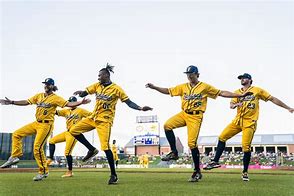 For anyone who’s not familiar, the Bananas are an independent team with a unique style of play known, naturally, as “Banana Ball.” There are 11 special rules, culminating in the Golden Batter Rule. It is just what it sounds like, and it’s certainly part of what makes the exhibition team special. Its brand is maximum fun by any means necessary, and there’s clearly a market for it.
What we have here is meant to provoke a reaction. Let’s call it take-bait. And hoo boy, is this one a doozy.
However, let’s be real. The Bananas’ product is not baseball. It’s a baseball-themed carnival and, therefore, not something you’d ever expect to be emulated by Major League Baseball.
That Manfred is nonetheless publicly talking about the Golden At-Bat implies the league is serious about the idea. And the reasoning sounds a lot like the distant rumble of the Four Influencers of the Apocalypse.
For someone with an Ivy League background and an ability to appreciate and conduct actual research such as Manfred is, that’s probably what I’d be most ticked off about.
There’s ample opportunity to test this theory out in a proving ground a tad more normal than a comedic road show. If Manfred and the owners were actually thinking about this as long as he contends they have been, they could have tried it out in this past fall’s Instructional League. They could test it out in some Winter League games in the Caribbean, perhaps with a donation to those financially struggling teams to help them better deal with being utilized as a de facto Petri dish.
Even a cursory look at how MLB games typically play out suggests a Golden At Bat wouldn’t make the impact on outcomes as dramatic as the proposition sounds. Appoximately 30-40 per cent of an average team’s games are played to a one-run conclusion; around half to two. Even the widest gap between major league hitters’ batting averages is no more than one-tenth of a point. While I know there are better minds out there who have access and ability to access more conclusive data, I’ll offer that scant few actual results will be impacted. I know that real baseball fans, especially the more stat-comfortable ones from those growing generations, know that.
Has Manfred even conducted focus groups, perhaps using those who are Bananas fans as a benchmark, to see how they’d even feel about such a radical change?
And what metric could be realistically used to assess any sort of experiment beyond sentiment? We’ve already pointed out the statistical likelihood of outcomes being impacted, and this sort of move wouldn’t move the time or production needle materially.
I’ve somewhat grudgingly accepted that the game I’ve loved has to evolve, and it absolutely needs more and different people from generations other than mine to survive, yet alone thrive. As long as each batter gets three strikes and each team gets three outs in an inning, I can cope with just about anything. Even a Golden At Bat.
I just would like to see someone else other than Rob Manfred and some unnamed allies like the one that Rymer referenced in this postscript to give me a concrete reason to do so:
As one team official told Jayson Stark of The Athletic:
“The world is changing. Look at the way entertainment is consumed now. Look who you’re competing with. Today’s fans have grown up on their phones…They’re used to getting exactly what they want, what they like, what they find engaging and compelling—and they want it now. And they want to watch it for a few minutes and move on. So the Golden At-Bat accomplishes all those things.”
I used to encounter media executives who would offer up those kind of grandiose opinions, based largely on how they observe their children’s viewing habits or the cursory conversations they’d offer up at the sporadic dinner table discussions they’d have. The remark to Stark is eerily similar. I’ve seen entire networks blown up by such anecdotal “research”.
I expect more from a theoretically nuanced mind like Manfred’s. And honestly, Commish, if you truly need help in doing so, there’s plenty of us out there that would be willing to help you do it right.
Courage…