

The 2025 MLB Winter Meetings in Orlando have wrapped up, and while the headlines focused on which stars landed with new teams, there’s a deeper economic narrative worth exploring. The contracts signed this week tell an interesting story when you look closer — one that suggests every player, agent, and front office executive in that ballroom is quietly bracing for the lockout that’s coming next winter.
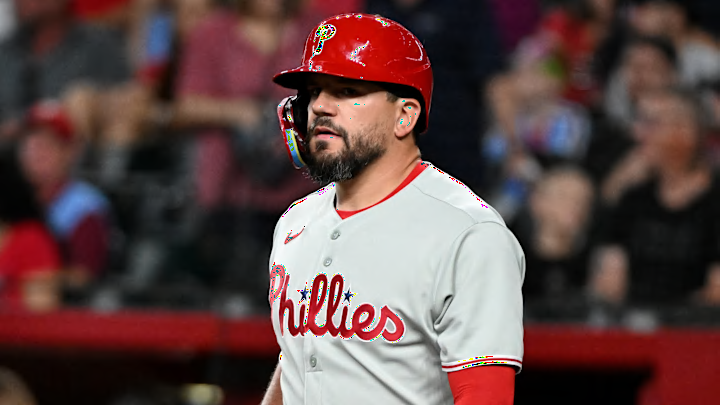
The marquee signings painted a familiar picture of free agency in December. Kyle Schwarber re-signed with the Philadelphia Phillies on a five-year deal worth $150 million, landing an average annual value of $30 million. Edwin Díaz headed to the Los Angeles Dodgers on a three-year, $69 million contract, good for $23 million per year. Pete Alonso, after striking out on his massive payday a year ago, finally secured that long-term deal he wanted — five years, $155 million with the Baltimore Orioles, averaging $31 million annually. On the surface, these look like healthy market corrections for elite talent. But here’s where it gets interesting: they also look like discounts compared to what these same players might have commanded in a typical free agency landscape.
The common thread running through every significant transaction at the meetings was this quiet, unspoken reality that everyone expects a lockout when the collective bargaining agreement expires on December 1, 2026. And not just any lockout, but one that could actually cost games in the 2027 season — something that hasn’t happened since 1994. That fundamentally changed how players and teams approached these negotiations, and it’s reflected in every contract signed in Orlando.
Consider the economics at play. If you’re Kyle Schwarber or Pete Alonso right now, you know that a lockout could wipe out a significant chunk of the 2027 season. You know that the owners are likely going to demand a salary cap for the first time in baseball history, something the players union has already rejected as non-negotiable. You know that Commissioner Rob Manfred has essentially said a lockout is the new normal and that the league will use it as leverage in negotiations. In that environment, wouldn’t you want to secure the certainty of a long-term deal now, even if the annual value isn’t quite what you might have gotten in a different economic climate?
The evidence supporting this theory is mounting in baseball circles. Both MLB and the MLBPA have already conducted preliminary meetings, with Dan Halem and Bruce Meyer — the lead negotiators for each side — laying out their diverging positions on the sport’s economics. Substantive bargaining isn’t expected to begin until spring training 2026, but everyone knows what’s coming. Tony Clark, the executive director of the MLBPA, has been explicit about labor expectations. Clark has stated that the union expects to be locked out after the 2026 season, making the timing of these Winter Meetings contracts all the more strategic.
Rob Manfred hasn’t exactly downplayed this either saying that a lockout is actually a positive and praised it as a superior alternative to in-season negotiations. He even used an odd metaphor about using a .22 caliber firearm instead of a shotgun. The point was clear, the league is prepared to use a work stoppage as a bargaining tool, and they’re not pretending otherwise. This kind of transparency about the league’s intentions changes the calculus for every free agent in the room.
When you layer in the significant issues — specifically the owners’ push for a salary cap, which the union has consistently maintained is an absolute non-starter — the lockout becomes not just likely but practically inevitable. The players know this. The agents know this. The teams know this. And that knowledge permeates every contract negotiation happening right now.
So what does a player like Alonso do? He could wait for the 2027 offseason, betting that he’ll still be in high demand and that a new agreement will be in place by then. But he’d also be gambling that a lockout might wipe out significant portions of his prime earning years, or that the deal he gets in 2027 might come with a salary cap in place that fundamentally changes how teams can spend. Suddenly, $31 million a year for five years starting now doesn’t look like a discount anymore — it looks like security. It looks like a guarantee that he gets paid while the sport sorts itself out.

The same logic applies to Schwarber, who locked in his money before things potentially get messy. Even Edwin Díaz, securing a relatively modest three-year deal with the Dodgers (the highest AAV ever for a reliever at $23 million, but still just three years), appears to have made a similar calculation. That short-term commitment with high annual value is actually a brilliant negotiating move in this environment — get paid well while you can, and avoid being tied to a team during what could be an extended labor dispute.
What makes this winter particularly telling is what didn’t happen. There weren’t any massive, nine-year mega-deals that would have been typical in stronger free agent markets. Instead, what we saw were strategic, medium-length agreements that get players paid now while preserving flexibility for an uncertain future. That’s not coincidence — that’s the market responding to the threat of work stoppage and economic upheaval.
The front offices read this same playbook. Teams that might have been tempted to go all-in on eight or nine-year commitments seemed to prefer the flexibility of shorter terms. The message was consistent: nobody wants to be caught with long-term financial commitments if a lockout disrupts the salary structure or fundamentally changes how baseball’s economy functions.
If a lockout does happen, and if it extends into the 2027 season and costs games, the landscape of baseball will be irrevocably altered. The 1994-95 strike cost the sport an entire postseason and damaged fan goodwill for years. A 2027 lockout that actually cancels games would be the first work stoppage with that consequence since 1994. The players and teams signing deals in Orlando this week know that possibility is real, and they’re pricing it into their negotiations accordingly.
Here’s the thing, folks: The owners want a salary cap. The players have said no cap, period. Both sides have said publicly that a lockout is likely. So when you look at what happened at the Winter Meetings and wonder why the AAVs seemed a bit lower than expected, wonder no more. These weren’t negotiations happening in a normal free agent market. They were deals struck in the shadow of a labor war that everyone expects to erupt in twelve months.
With that… What happened this week was the calm before the storm, and the contracts being signed reflect that reality. Players got paid, teams made their moves, and everyone went home quietly understanding that next winter is going to be a lot messier than this one.
If you cannot negotiate with them, then you should root for both sides to be happy!