
NOTE: This also appears today on our sister site Leblanguage. Please visit it regularly for coverage of media, politics, sports and life.
I’ve probably spent more hours of my life consuming sports than I have working or indulging in any other pasttime. Therefore, I’d contend I’ve developed more intimate relationships with sportscasters than practically anyone else on Earth, one-way though those relationships may be. Not that that differs all that much from a majority of my work and personal ones over the years–which I’ll allow is the primary reason I’ve spent so much time consuming sports in the first place.
So when a voice of many generations passes it’s more of a personal loss than the deaths of other celebrities provides. Sure, I respect and admire plenty of other talented folks–some of them I’ve actually been able to call colleagues and friends. But in the particular case of announcers, considering how many long car rides, sleepless nights with a transistor radio and then a smartphone under my pillow, and lonely nights in strange hotel rooms I’ve had over my lifetime the degree of connection grows exponentially. And with those who cover baseball, considering that including exhibitions and post-season their arcs typically run from just past Presidents’ Day to just before Halloween, it’s an even stronger bond.
As a result, the news that THE ATHLETIC’s Brendan Kuty dropped yesterday morning was all the more jarring and tear-jerking:
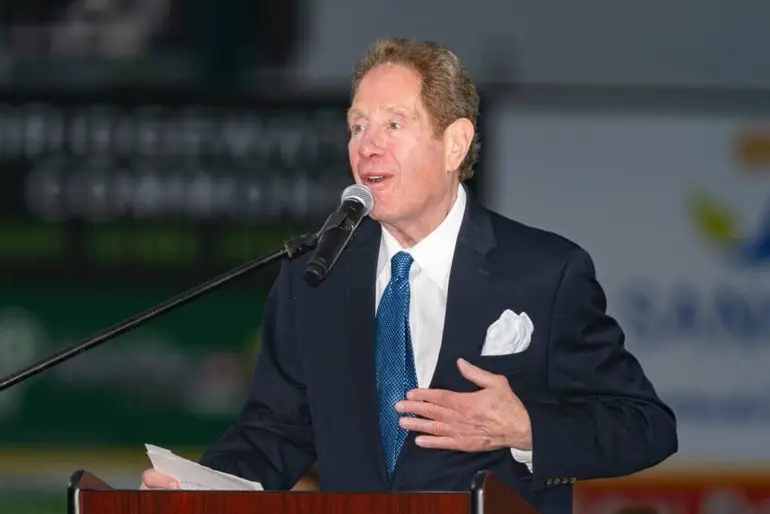
John Sterling, whose tenure as the New York Yankees’ radio voice spanned more than three decades and five World Series wins, and whose bombastic delivery and idiosyncratic catchphrases earned him a nomination to the National Baseball Hall of Fame, died Monday at the age of 87…Sterling became the Yankees’ play-by-play announcer in 1989 and spent 36 years in the position, calling 5,060 consecutive games (plus 211 more in the postseason) until he missed his first game in July 2019. He called 5,651 Yankees games, including eight World Series appearances.
His run covered one of the Yankees’ greatest eras. He called every game of Derek Jeter’s 20-year career and every pitch thrown by Mariano Rivera. He emceed the uniform number retirement ceremonies for Jorge Posada, Andy Pettitte, Bernie Williams and Joe Torre, among others. He was there when Aaron Judge crushed his American League single-season record 62nd home run in 2022… By the time he retired in 2024, he was known as “The Voice of the Yankees.”
I’m seasoned enough where I initially thought that title was something naively bestowed upon him by a younger generation more disconnected from the team’s impressive past than perhaps myself and my fellow Medicare recipients. I don’t go quite far back enough to remember the 12-pennants-in-15 years run that essentially defined Yogi Berra’s firsr run, but I’ve seen enough surviving footage to know Mel Allen earned that distinction in that era. 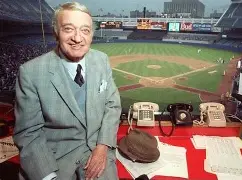 I do vividly remember the renaissance of the late 70s where Phil Rizzuto was front and center among a memorable trio that covered the team on both radio and television. They both had unique quirks that strengthened their bonds with their fans–Allen’s folksy delivery punctuated by “How About That!” and the sponsor’s homage “A Ballantine Blast”;
 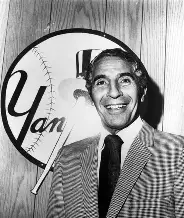 Rizzuto’s version of “Holy Cow!” (not to be confused with Harry Caray’s) and his confessed aversion to inclement weather that would have him leaving games played on overcast days and nights early to head over the George Washington Bridge to Cora and the kids in northern New Jersey lest he get caught up in the ensuing traffic.
 Sterling incorporated elements from both of them into his coverage, not to mention what to many seemed to be borrowing a page from ESPN’s Chris Berman with a repetoire of references to specific players, a point Kuty made certain to call out:
Sterling, a member of the New York State Broadcasters Hall of Fame, featured a distinctive baritone and drew adoration and criticism alike for his eccentricities and his unabashed Yankees fandom that resonated in his broadcasts. He marked victories with a thunderous “The Yankees win,” perhaps his most popular line. He personalized home run calls for players, starting with “Bern, Baby, Bern!” for Williams. He eventually had calls for every player, including “An A-bomb from A-Rod” for Alex Rodriguez and “Robbie Canó, don’t you know?” for Robinson Canó…Sterling’s peculiar speech patterns included sing-song inflections and the tendency to exaggerate the word “the.” Before a pitcher delivered the ball, Sterling would say, “Thuuhhh pitch.” After the final out of a victory, it was, “Thuuhhh Yankees win!”
To me his even greater accomplishment was the fact this chapter began when he was already 50 years old and effectively tossed out of the New York market on his tuchas. I first heard him as a flashy young upstart on a nightly call-in sports talk show on the tin can known as WMCA Radio, a poor man’s version of a similarly evolved ex-rock and roll turned talk radio station with a far more powerful signal, 77 WABC. He replaced the much more paternal ex-disc jockey Jack Spector, who I got to talk to on several occasions, usually about the Mets–I suppose his audience was that small. He became the station’s play-by-play man by default, first for the WHA’s New York Raiders during its lone year of existence. 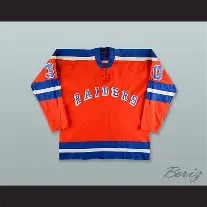 The first pro hockey game I saw involved those semi-competitive Raiders, who shared Madison Square Garden with the Rangers but wound up being scheduled for plenty of weekend afternoon slots as the afterthought tenant that they were. He bestowed the nickname “The Lone Raider”–a pointed jab at the establishment–on their mediocre goaltender Peter Donnelly. A few years later, he moved on to the New Jersey Nets during the initial days toiling before half-empty stands on the campus of Rutgers University in Piscataway, effervescently calling their surprising playoff run in their Garden State season bestowing the nicknames “Sky” and “B.B.” on then up-and-coming star Bernard King and “Super John” on their flamboyant Afro-coiffed guard John Williamson. To this day, I remember how he’d exclaim how they were such a “gutty, grippy, grimy team” so loud that it would echo through the lack of a crowd making the broadcast sound still more tinny.
He wound up getting canned when the Nets (and the Islanders) became more successful and thus in demand, leaving New York even before I did. He re-emerged to some extent as a member of the TBS Superstation crew that covered the God-awful Braves of the mid-80s, eventually getting his second chance because it turned out Yankee czar George Steinbrenner watched as much baseball as I did and had liked what he heard. The rest was history–especially if you didn’t live through the earlier years.
Katy’s colleague Andrew Marchand falls into that demographic and waxed both reverent and eye-rolling at once:
He…was from another time: He read physical newspapers and books, didn’t own a smartphone, and, even though on the radio, he would wear a tailored suit, tie and dress shoes to each and every game…He was far from perfect. If you were listening on the radio and wanted to know if the ball was, in fact, actually high or far or even gone, you might have been out of luck. This aspect became fodder for critics, from fans to writers to even on The FAN, the home of Yankees baseball in Sterling’s latter years, where hosts would goof on replays of missed calls.
But he proved to be ubiquitous and resillient, even coming out of a brief first retirement toward the end of the 2024 season to have one last crack at calling a World Series victory. He didn’t quite get that, but he did get to intone his “AMERICAN LEAGUE CHAMPIONSHIP SERIES OVER!!!” once more. Yep, I was listening–thank you, Sirius XM. The 15-year drought between league titles was exactly the same gap that the Yankees endured between 1981 and 1996. Sterling’s call of Charlie Hayes’ catch in foul territory to complete their comeback over the Atlanta Braves will remain as iconic a call as any in team or baseball history–the emotion in his voice when he provided the catharsis for pennant-starved Yankee fans when they clinched their series over the Cleveland Guardians was just as genuine and deep all those years later.
I’m on record noting that when I die I want to die the way Tommy Lasorda did–in the off-season after my team won a World’s Championship so I’ll never know a world where they weren’t on top. Sterling didn’t quite get that distinction but his last full day on Earth did feature a Yankee win and they currently have the best record in the American League. On the night following his passing they completed a four-game sweep of the division rival Orioles, with this exclamation point that USA TODAY’s
As fate would have it, Aaron Judge presented the perfect moment for the team’s current broadcasters to honor the iconic broadcaster. In the bottom of the first inning, Judge launched a two-run home run, and Yankees play-by-play announcer Michael Kay did his best Sterling impression… “It is high! It is far! It is gone! Aaron Judge! A Judgian blast! Here comes the Judge!” Kay roared into the microphone during the broadcast on YES Network.
And of course, thuhhhhhhhh Yankees WON!!!! As did their fans when they had him as their constant companion, With, as his might have allowed, respectively sterling performances.
Courage…