
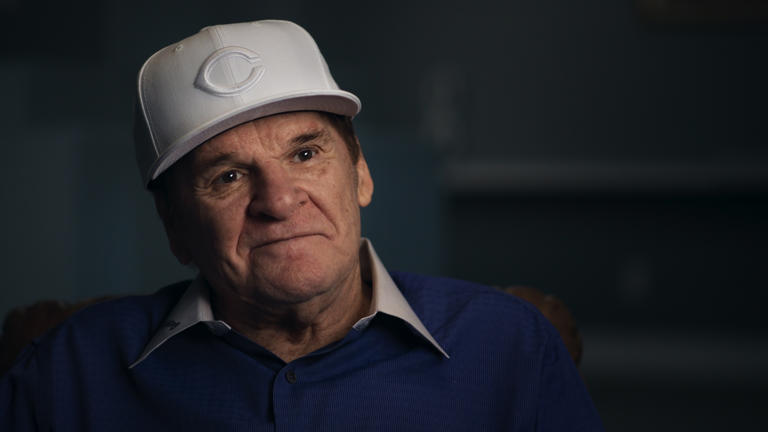
Despite the best efforts of David Zaslav to systematically destroy the good name of HBO, on occasion even their legacy businesses rise up to provide the kind of thoughtful and entertaining quality they built themselves on in their glory days. HBO Sports may be a shell of what it once was, but its documentary division is still active, and over the last two nights, with the opportunistic window of post-Republican Convention and pre-Paris Olympics, they unveiled a provocative and balanced look into the complicated world of Pete Rose.
It’s now been 35 summers since baseball banned Rose, the sport’s all-time leader in base hits and many other categories. As THE CHICAGO TRIBUNE’s Nina Metz recapped:
By his stats alone, Pete Rose was one of Major League Baseball’s greats. But in 1989, he was banned for life after an investigation found he was betting on his team’s games during his time as manager of the Cincinnati Reds. In the years since, he’s launched campaigns lobbying for a reversal, but offered little by way of contrition. At 83, after all this time, he might be incapable of it. Even so, the four-part HBO documentary “Charlie Hustle & the Matter of Pete Rose” is a searching look for one man’s conscience.
Baseball fans of a certain generation have debated for decades whether Rose should be enshrined in the Hall of Fame for his on-field accomplishments. I had the thrill of watching Rose play in person numerous times, most notably when he hit in his 38th consecutive game before an atypically large 1978 Shea Stadium crowd in the midst of what eventually tied the all-time major league record for a consecutive game hitting streak with 44. At the time, the woeful Mets just happened to employ the long-forgotten Boston Brave who had held that mark, Tommy Holmes, in their ticketing department, making for a truly lovely moment where he was brought onto the field to congratulate Rose and having Rose offer him the ball that he had just received that he had laced past a diving Frank Taveras for that record-breaking hit. It was the kind of moment that an outsized personality like Rose was often capable of shining in , and actually had a few Mets fans forgive him for nearly breaking Bud Harrelson in two in a still-remembered dust-up in the middle of a playoff loss on the same field five years previously.
But there’s no stronger emotional attachment to Rose than from the fans of Cincinnati itself. As Metz continued,
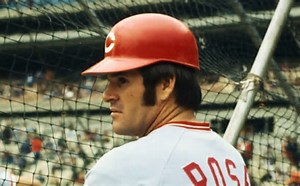 Rose’s career in baseball began in 1963 and he was the rare player who spent most of it with his hometown club (born and raised in Cincinnati). He had the blue-collar persona of a grinder that made him a fan favorite.
And as NEXT TV’s Michael Malone added:
The first episode, called “The Longshot,” looks at Rose growing up in Cincinnati and moving up to pro baseball. Jon Miller, former MLB announcer, said Rose was a perfect emblem of Cincinnati–a player who didn’t have the most God-given talent, but one that punched well above his weight. An underdog. C. Trent Rosecrans, who covers the Reds for The Athletic, added, “In some ways, good and bad, Pete Rose is the embodiment of this city.”
 The second episode, called “The Dirty Work,” sees Rose receive his baseball ban. It also looks at his departure from his hometown Reds, leaving for the Philadelphia Phillies in a four-year, $3.2 million deal that made him the highest paid player in 1979. “He grew up in Cincinnati. He is Cincinnati,” said filmmaker and fan Chad Lowe. “How can he leave?”
But as someone who has embodied those feelings both professionally and personally for decades, his hometown CINCINNATI ENQUIRER’s Dave Clark offered, the mere act of watching this was as complicated as the subject itself:
You get some great Big Red Machine highlights and history. You get good background information about Pete’s career, gambling addiction, statutory rape allegations and more. There’s enough of Pete patting himself on the back for his accomplishments (including comparing Joe Burrow’s success in Cincinnati to his own, which apparently didn’t keep Pete from betting on the Rams to beat the Bengals in the Super Bowl) to turn your stomach. Pete makes it very clear he’s still campaigning for reinstatement, and his effort in the documentary to minimize his mistakes, lies and poor behavior is tough to swallow.
(T)he interviewer, to his credit, does ask Pete some tough questions, and Pete appears to get perturbed as only Pete can. And some eye-opening quotes emerge from Al Michaels, Marty Brennaman, Pete Rose Jr., “Dowd Report” author John Dowd, and, of course, Pete himself.
“Well, what do you want?” Pete told the interviewer. “You want to cut my balls off? I mean, enough is enough. You know, all I did is bet on baseball. I didn’t rob banks. I didn’t go around knocking up girls. To be honest with you, I guess I’m telling the truth when I tell you: The only bad quality I had was I gambled on baseball”.
 When one hears the despair and determination in Rose’s voice as he laments his inability to have made a dent in the numerous commissioners that have followed Bart Giammati into the office of MLB czar, the first taking office a mere eight days after the Rose verdict when Giammati was felled by a massive heart attack, you almost can’t help but be a little taken by his plight. Even he knows he can’t hustle mortality, and it’s evident his greatest fear would be to be forgiven after his death by a perhaps more distant and less judgmental generation. And in particular a segment of that detached youth that seems to be OK with the transgressions of a senior citizen, convicted felon and misogynist—in this case, one who can’t even find the words to apologize to a female reporter from a Philadelphia newspaper, who we see directly confronting him about his use of the word “babe” to address her. It fell on Rose’s older male friends to offer the words “I’m sorry” that never crossed his lips in the wild footage of it the documentary showcased.
It’s hard not to compare Rose with, say, the Republican candidate for President. And I suspect that would be an even easier comparison for someone who hails from an area of Ohio not all that far from Cincinnati who clearly has no problem with such forgiveness and reverence to make. Maybe you might have seen such a person last week when he became the Republican candidate for vice president.
But for broadcasting legend Al Michaels, who arguably knows Rose both professionally and personally as well as anyone offered up as quoted by Clark, even the mere contemplation of empathy is not without its qualifiers:
“People say to me, ‘Don’t you think what happened to Pete is tragic?'” Michaels, the Reds’ broadcaster from 1971 to 1973, said during the first episode of the documentary. “And I say, ‘No, tragic is a different story. The word I use for this is sad.’ It’s a shame. It really is. What he did (as a player) is just so phenomenal and unbelievable. This guy should be one of the most exalted athletes in history.”
“I think Pete really believed that he didn’t do anything wrong for a long, long time,” Michaels continued. “And then it just became kind of a mess through the years. He was in denial. I don’t know that he’s all the way back. Obviousvly, you have to have Pete tell his own story. But I would listen carefully. You have to sometimes listen between the lines. Is it the whole truth and nothing but the truth so help him God? I don’t know. I don’t know. Your brain plays tricks on you too. Maybe in his mind he thinks that is the case.
I know I felt that way while watching this. I still don’t know how I’d feel if Rose was indeed granted his wish to be considered for election to Cooperstown in his lifetime. As Rosecrans reminds, the current enshrinee that Rose has the most in common with, both in playing style and attitude, was the man whose all-time hit record was broken on a glorious September night early in Rose’s tenure as player-manager on his homecoming stint with the Reds, one Ty Cobb. Cobb was revealed to be a unapolgetic racist, a product both of his time and his Georgia upbringing. Anyone from the West Side of Cincinnati, from the Rust Belt of Ohio, from indeed as representative a world as any Hillbilly Elegy author, could relate to better than I. Isn’t that right, James Bowman?
So I suppose if people like Bowman–his real name, incidentally–and said Republican candidate have a chance to win election and reverence in these times, it’s not all that impossible to at least consider Rose as still having a fighting chance for his own retribution.
Regardless of who you think should hold an office or be enshrined in an institution self-defined by “fame” rather than character, CHARLIE HUSTLE is definitely worth your watch and your time. Especially now.
Courage…