
NOTE: This musing also appears today on our sister site, Leblanguage. Please visit it regularly for coverage of sports of all sorts plus articles on technology.
As you’ve likely discovered if you’re even a casual visitor to this space, I tend to be a stickler for detail, at times almost obsessively. I don’t always deliver on that goal–plenty of y’all have caught typos and occasional errors in conclusions I draw from a sometimes faultier memory than I’d like to have at this point. And while I’m grateful for such feedback, it does tend to ruin my day.
But when I see how confused and complicated some that cover the media space these days make what to me appears to be a foregone conclusion, I wonder if my talent isn’t merely a curse. They seem to be able to hold down and command jobs that I frankly believe I could do better, and indeed once did.
Take if you will the muddled attempt of FRONT OFFICE SPORTS’ Eric Fisher and Colin Salao to try and recap the results of Netflix’s initial foray into weekly live content that happened Monday night–or as we now know it in these parts, a few hours before Armageddon hit this fair city:
The partnership between WWE and Netflix is off to a hot start.
 Netflix announced that Raw’s streaming debut Monday averaged 2.6 million viewers in the U.S., up 116% from the 2024 household average of 1.2 million, according to VideoAmp. Nielsen, which Netflix did not use for this measurement, estimated Raw averaged about 1.6 million viewers per episode last year.
Comparing the Nielsen data with the VideoAmp data, the Netflix debut is up 49% from the show’s first episode of 2024 on the USA Network. The number is also higher than any episode of Raw in 2024, when it breached two million viewers just once, on April 8, the Raw that followed WrestleMania 40.
That’s all well and good. Yet what I perceive to be the bigger story was buried well below that spin–the one that focused on what Netflix’s real advantage is versus its competition:
The Netflix debut delivered for WWE in that regard, as Raw attracted 4.9 million global viewers.
Not quite, kemosabe. That’s views, which is a different metric, and the one that Netflix is utilizing as a more significant internal KPI. USA TODAY’s Jordan Mendoza seemed to have a better handle on the significance of that number in his writeup which dropped yesterday:
With the move of Monday Night Raw to Netflix, WWE executives believed it would be able to expand its viewership globally. One show in and the results indicate a big day for the show’s debut on the streaming service. Netflix said the viewership numbers are the total view hours for the program divided by runtime, and it likely doesn’t provide the full scope of how many viewers tuned into the show. Netflix doesn’t yet distribute WWE shows in 92 countries and territories, including France, Germany, India and Japan among others. “The early numbers are strong, and they’re very pleased,” WWE chief content officer Paul “Triple H” Levesque said after the show. “Look to be very impressive.
And the fact that opinion is now being expressed by someone not named McMahon should underscore why the insights of a true fan like CINEMABLEND’s Philip Sledge are as significant as any numerical post-mortem:
Finally… WWE’s Monday Night Raw has debuted on Netflix, starting a new chapter, or era, as the company likes to call it. The premiere episode, which is streaming for anyone with a Netflix subscription, had a lot going on with The Rock’s confusing return to the company’s flagship show, John Cena kicking off his farewell tour with a tease for the Royal Rumble, and Hulk Hogan getting mercilessly booed by the WWE Universe, and some great TV matches in the three-plus-hour show.
And THE HOLLYWOOD REPORTER’s Mikey O’Connell seemed to channel my own thoughts as a far more casual fan in his piece from Wednesday:
Netflix compelled me to sit through an entire three-hour outing of WWE flagship Monday Night Raw.A love of comped tickets to brand new arenas brought me to Los Angeles’ Intuit Dome, but what kept me there was a sincere curiosity about how easily this wildly popular yet wildly niche spectacle might potentially court new fans.
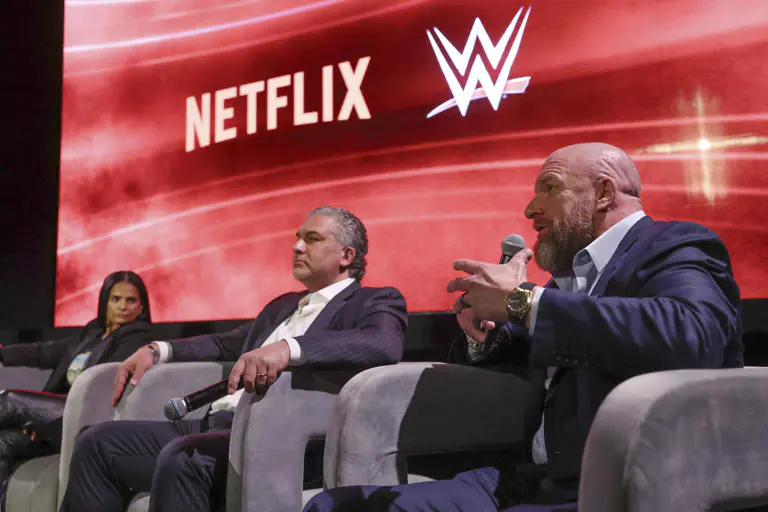
WWE’s move to Netflix isn’t just another box in the grid of sports rights bingo. It’s part of conscious effort, in wrestling’s new era, to scale its success globally. The massive entertainment sports brand counts an estimated 90 million fans in the U.S. alone, and the possibility of Netflix growing that base among its 282 million subscribers in more than 190 countries is tantalizing for all parties. WWE president Nick Khan said as much at a December preview of the new partnership, touting Raw’s Netflix move as a bid to boost to its “global flair.”
 I do realize that there’s a lot of apples and oranges comparisons inherent here, what with views vs. viewers and Videoamp vs. Nielsen. It would be incorrect to assert as some writeups have that a little less than half of the total views. But regardless of what the specifics may or may not be, or how much of the world is currently capable of seeing this spectacle, the fact is that millions of people regardless of time zone or language found their way to a common media destination at the same exact time. For a company that introduced the phrase “new world order” more than a quarter-century ago, this is indeed an event that’s worthy of that monicker.
Which yet again begs the question–why isn’t someone– Nielsen, Videoamp, or a third party in waiting–developing a global measurement panel to actually measure this phenomenon instead of exclusively relying upon Netflix to write its own report card? Nielsen has already shown a willingness to partner with a client panel to augment their measurement gaps via their partnership with Prime Video on NFL Thursday Night Football. Despite the objections of broadcast competitors, both parties are moving forward and advertisers are increasingly willing to accept the higher numbers. And as Netflix itself demonstrated with its own Christmas Day NFL numbers, where global views only resulted in an augmentation of roughly 20 per cent, the potential for wrestling to have a far more significant boost from non-U.S. measurement is already significantly greater.
As we’ve previously mused, Nielsen is perhaps best suited to do this, having measurement panels in several countries beyond the U.S. already. A third party could seek alliances with comeptitors that are measuring video consumption in Netflix’s current WWE footprint. But if these admittedly first blush results are showing us anything, it’s that the opportunity and the necessity are both in the here and now.
So I’m truly hoping that as Netflix and WWE move forward and demonstrate that despite the negative Nellies out there a significant global audience will continue to show up week after week–what true wrestling fan would deny that’s not already the case?–someone will finally begin the process of providing that service. It’s the lowest hanging fruit I’ve come across in quite a while.
 Is it going to take an event of biblical proportions to propel someone to do it? As someone who saw something like this on his evening commute last night, I’d contend that’s already happened.
Until next time…