
NOTE: This also appears today as part of a year-end series of PREDICTIONS & WISHES on our sister site, Leblanguage. Please visit it regularly for musings on media, politics and life.
If we’ve learned anything from the unpredictable and chaotic world of streaming, it’s never say never. And based upon the events and results we’ve seen this week, that truism has never been more appropriate.
 Pretty much since its inception even hearkening back to its DVD mail order roots, Netflix’s value proposition had been rooted in entertainment, curating a large enough array of titles to suck you into a limitless vortex of movies and episodic television and then making its own original content just in case you happened to actually finish a dozen or so libraries in a single binge. Particularly when the pandemic shut down all live sports for the spring of 2020, Netflix became a de facto lifeline and arguably the poster child for quarantine entertainment. Even when things began to sort of normalize it was more evident than ever that it was a “Netflix and chill” world and all of these upstarts from traditional media and tech would be left with the scraps.
But a funny thing happened along the way, particularly for its arch-rival Prime Video. Opportunity and a cadre of new executives with strong ties via FOX to the NFL led Amazon to seemingly overpay for a struggling Thursday Night Football package that both FOX and the NFL Network were not all that thrilled with. Ratings-wise, they were still way better than anything else either was offering on a typical weeknight, but the expense simply wasn’t being justified. In the streaming world, money is far less an object or deterrent. And besides, as even archaic broadcasters have learned, there’s little that can provide an impactful promotional platform better than NFL football. After some initial hiccups (and despite perhaps the worst-played game of the entire season last night), Prime Video has seen its best numbers in its three-year history, convinced Nielsen to partner with them to goose them still further by factoring in what they still can’t measure, and provided an irresistible access point to entice ad-tier subscribers to sign up and/or stick around.
Don’t think Netflix didn’t notice. They didn’t get to a position of SVOD dominance by playing nice. And they have slowly but surely backing away from their initial hesitancies into embracing live events, sports and advertising. A thoughtful piece that dropped earlier this week by THE VERGE’s David Pierce recapped the journey:
 Brandon Riegg has spent the better part of a decade trying to make live TV happen at Netflix. He joined the company in 2016, after stints at NBC, ABC, and VH1, where he’d worked on shows like Dancing with the Stars, The Voice, and America’s Got Talent. All those shows were the kind of unscripted reality fare he’d been hired to bring to Netflix, but they also incorporated things like live voting to make the whole thing feel more urgent and interactive. “I just felt like, if we’re really trying to be the preeminent entertainment service in the world,” Riegg tells me, “we should have all the tools at our disposal.”
So Riegg and Bela Bajaria, another longtime TV executive who joined Netflix around the same time and is now its chief content officer, began making the case around Netflix for why it should invest in the tech required to make live content work. Over and over, they got the same question: What do you want to do with it? And for years, Riegg says, they didn’t have a great answer. “I’d go, ‘Well, I don’t have something specific right now, but I want to be able to jump on things that require live capability if those things come up.’”
Netflix has spent the last two years slowly learning how to do live programming and live streaming. It started with a Chris Rock comedy special last March, which was a technical success and a cultural hit. A few weeks later, it did a live Love Is Blind reunion show, which was such a spectacular disaster that the reunion wound up being filmed and released later. Then there was a live feed of baby gorillas at the Cleveland Zoo, a strange golf event that teamed Formula 1 drivers up with PGA pros, the SAG Awards, a tennis exhibition, a roast of Tom Brady, and John Mulaney’s slightly unhinged late night show Everybody’s in LA.
All that was, in some ways, just practice. Because the real tests of Netflix’s live prowess came this fall. First, the Jake Paul / Mike Tyson fight in November, which the company says was watched by more than 65 million Netflix subscribers around the world — and had lots of technical difficulties and delays of its own.
And on Christmas Day, forged by the opportunity presented by the NFL when it decided they weren’t going to let the fact that the holiday fell on a Wednesday deter them from scheduling games–thereby opening up a bidding war for ther rights–Netflix determined this was the moment they would take on the world of live sports full tilt. As THE ATHLETIC’s astute Richard Deitsch observed from his safe haven north of the border, they were the perfect partner for this mutual dive into the deep end:
Netflix paid $150 million to air Wednesday’s games. That’s a rounding error for a company that has 282.3 million subscribers in over 190 countries.
Even when one tries to incorporate both spin and substance into the post-mortem, results released yesterday point to this being a big win for our friend Teddy Bear and his foresightful lieutenants. The spin, courtesy of BLEACHER REPORT’s Tim Rapp:
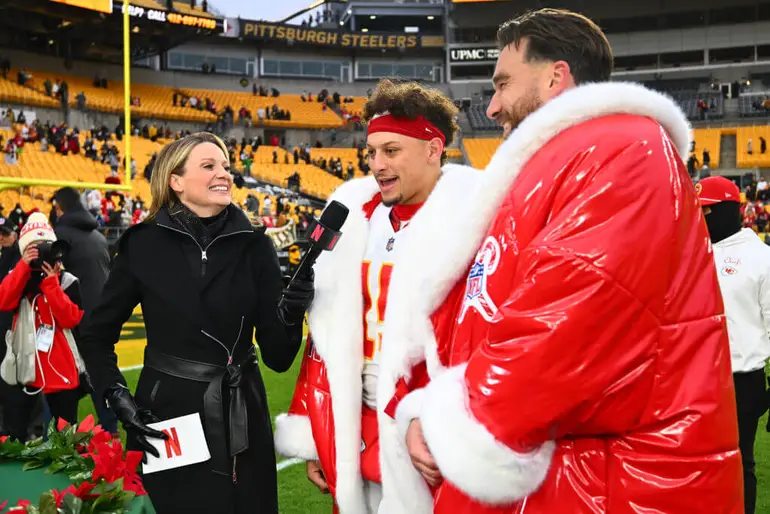
 Netflix released its Christmas streaming viewership numbers on Thursday, saying that the Kansas City Chiefs vs. Pittsburgh Steelers and Baltimore Ravens vs. Houston Texans matchups drew 65 million viewers across the United States. Netflix entered the NFL streaming game on Wednesday with its pair of NFL broadcasts, with the Ravens vs. Texans posting a 24.3 million average minute audience and the Chiefs vs. Steelers notching a 24.1 million average minute audience. The previous streaming record for an NFL broadcast was the AFC Wild Card Round matchup between the Chiefs and Miami Dolphins in January on Peacock (22.8 million), per Jon Lewis of Sports Media Watch.
The substance, courtesy of Deitsch:
Those games were down five million viewers from last year’s Christmas Day games (29.5 million for Raiders-Chiefs on CBS and 29 million viewers for Giants-Eagles on CBS)…As for the Beyonce fans: Her set averaged 27 million during the Ravens-Texans halftime.
As well as YAHOO! Sports’ Jack Baer:
 The early returns for Netflix’s NFL games are similarly encouraging, as it reported nearly one third of its global subscribers, coming in from over 200 countries, tuned in for at least part of the earlier game Wednesday between the Chiefs and Steelers. On the NFL’s side, success with Netflix would be significant for two of the league’s biggest priorities, as it offers both a large international audience and the ability to prepare for an increasingly streaming-heavy future. The NFL is hardly hurting for ratings these days, but it’s not going to turn down an opportunity for yet another enormous revenue stream.
All this–and potentially more, once Netflix’s more detailed global figures are released next week–for two non-competitive regular season games.
So I’m using all this for an aggressive prediction that there will be much more NetFLix synergy ahead. Starting with a full partnership as soon as the 2025 season where the rights to all available international games–inclusive of the league’s desire to eventually have at least one game outside of the United States every week of the season–will be Netflix’s alone. The majority of those games fall in Sunday morning windows in the U.S. and have been mostly confined to the NFL Network –essentially what Thursday Night Football started out as. We’ve already seen what moving to a streamer can do to invigorate and add importance to such a package. Morever, the fact that these games are airing at more crucial times of the day in Europe and Asia add to the value they can bring to Netflix. The ability to measure and sell spots globally (and, hey, Nielsen, since you’re copacetic with allowing Amazon to bump up your capabilities, think of what a platform available in 190 countries can do) is compelling.
And since Netflix would then be in the business on a more frequent basis, what’s to stop them from partnering with–or perhaps fully absorbing–the in-limbo NFL Network as opposed to the lend-lease arrangement they cobbled together for both on and off-air talent on Wednesday. You don’t think the league wouldn’t salivate at the prospect of real international exposure for Rich Eisen and company, not to mention taking the hassle of trying to get U.S. ratings on a sustaining basis off their hands? As BARRON’s Adam Clark reported this morning, even on a meh day Netflix looks like they’ve got the resources to do that and more, and would apparently be motivated to have the NFL help them:
 Netflix shares were down 0.5% at $919.47 in premarket trading on Friday, having fallen 0.9% the previous day. With Netflix’s shares having risen 90% this year so far through to Thursday’s close, investors might feel wary of chasing the shares higher before seeing further evidence of how the company’s investment in live sports will pay off.
Netflix has already announced several additional initiatives stemming from this experience, as Deitsch detailed:
The streaming giant and the NFL announced a three-season deal in May to air Christmas Day games in 2024, 2025 and 2026. That deal becomes even more magnified given Netflix recently secured the exclusive broadcast rights in the United States for the 2027 and 2031 editions of the Women’s World Cup. These are significant signals to the marketplace that Netflix is moving from a focus on sports adjacent properties to a legitimate sports rights holder. So is another Netflix foray into live events — the company’s deal for exclusive rights to WWE Raw, the long-running weekly pro wrestling staple.
A weekly presence would further amplify these commitments, and would certainly clear the path for a playoff game down the road–just like Prime Video is getting its chance with next month, supplanting Peacock in that role. And hey–at the end of this decade, the NFL has the option to opt out of its current deal with those archaic broadcasters. Streamers have already proven they can deliver effectively comparable domestic audiences as well as the significant upside of concurrently measured global reach. There is no question that they would continue to appease lawmakers and lobbyists by making games available in home markets via over-the-air free stations–which is far and away what traditionalists scream for when they bitch and moan about ordinary folks having the “right” to see NFL football. As well as the reality check that its current Sunday afternoon partners, CBS and FOX, are both entering into uncertain waters with impending management changes.
 So I’m adding as a bonus prediction that the eventual Netflix package will be one of those Sunday afternoon deals, along with accompanying Sunday Ticket distribution and yes, a Super Bowl in rotation. Admittedly, that’s for another year beyond ’25. But remember–never say never. Right, Teddy?
Courage…