
NOTE: This musing also appears today on our sister site, Leblanguage. Please visit it regularly for coverage of media, sports, politics and life.
I was literally on the cusp of the purported target demographic that ESPN was going after when it took full advantage of the demand for additional channels that the advent of digital cable and satellite TV when it launched ESPN2, affectionately called “The Deuce”. Judging by the way it insisted its young turk talent dressed, it may as well have been dubbed the “Forty-Deuce”. The nerdy and snarky Keith Olbermann, already to me a familiar face from his earlier stints on such strong local news stations as Boston’s WCVB and Los Angeles’ KTLA, was decked out in a leather jacket that emphasized his porn-stache and uber-creep personality, and when cast with equally glammed versions of otherwise strong female anchors like Suzy Kolber and Deb Kaufman it looked like they had been recruited for his latest work of art. What management deemed as younger-skewing content, such as the afterthought of NHL hockey and the embryonic X Games, were relegated to this spinoff, surrounded by an over-the-top re-imagination of ESPN’s winning formula of graphics, music and depth as if Bristol had been taken over by a group of Greek pledges with access to a darn good weed dealer.
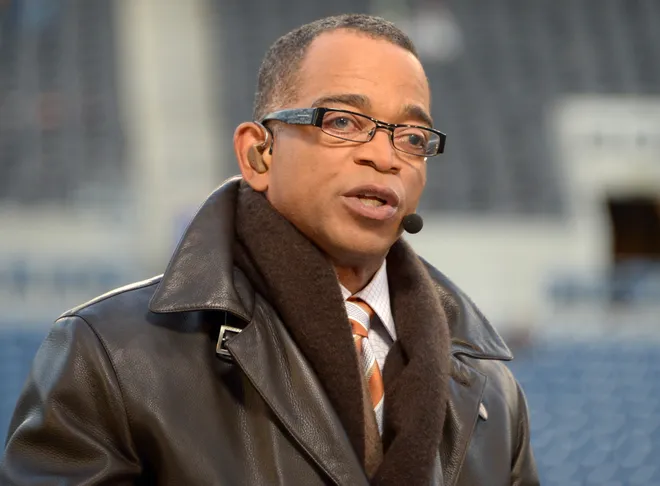
 But in the midst of this mess was the effusive, engaging anchor of what ironically was an otherwise traditional five-minute recap of the day’s actual sports news freshly recruited from Orlando, which at the time was one of the fastest-growing and progressive local markets in the country. So I would eagerly look forward to when Stuart Scott would pop on and I began to look forward to his catch phrases and shtick as much as I did (and still do) of those from Chris Berman, who is much closer to my demographic and sense of humor. I didn’t always get Scott’s frequent hip-hop inspired narratives and patter, but I sure did appreciate the passion he delivered it with. And on him, even leather and colorful prints looked both age-appropriate and appealing.
I identify even more with the opinion offered by his longtime on-air partner Rich Eisen in ESPN’s latest 30 for 30 documentary BOO-YAH!, which it belatedly debuted last night after the battle for Iowa women’s college basketball supremacy ran a little late. Eisen, who Scott was deftly teamed up with once the “Deuce” gang was rescued by the mothership as they aged into its demographic and shed their kink wardrobe for slightly more traditional garb, related that Scott would defend his approach with reminders like “Look, you can have all the Seinfeld references you want. This is how I speak; this is what folks like me are looking for”. And considering his fan base and personal friends included the likes of Michael Jordan and Shaquille O’Neal, he had a point.
 BOO-YAH! takes a deep and at times heartbreaking dive into the life and times of Scott, appropriately scheduled as the conclusion to the company’s annual “V” week where it schedules special programming designed to convince viewers to donate to cancer research. The effort started around the time that Scott first joined the network after the untimely death of its popular college basketball analyst and national championship-winning coach Jim Valvano. Valvano succumbed at age 47, leaving behind a legacy speech at the inaugural ESPY awards where riddled with cancer he implored viewers with his stirring “don’t give up, don’t ever give up”. Scott actually matched and arguably eclipsed that effort when he was the recipient of the award that Valvano inaugurated in what turned out to be his last public appearance in 2014, a speech where, as USA TODAY’s Scooby Axson reminds, he reminded that “(y)ou beat cancer by how you live, why you live, and the manner in which you live.”
Were that the coda to BOO-YAH! it would it would have been a more than worthy journey that chronicled a mercurial career where Scott became a cultural icon, which THE ATHLETIC’s Zach Powell pointed out in his review:
The documentary reveals Scott’s rise through the sportscasting industry and the impact of mixing Black culture and sports with personality. The background of Scott’s verbiage is on display. His wording isn’t always proper, but that’s his intent. It was something that resonated with athletes and viewers who shared his skin color.
 Scott, who died Jan. 4, 2015, at 49 after a seven-year battle with cancer, is often remembered for his hip-hop style and catchphrases such as “Boo-Yah,” “Hallah” and “Just call Michael (Jordan) butta’, ’cause he’s on a roll,” to name a few…He paved the way for many sports broadcasting personalities, such as Jemele Hill, Chris Broussard and Stephen A. Smith, who also brought their cultural identities in front of the camera.
But in the deft hands of a filmmaker like Andre Gaines, who has previously produced seminal works on the lives of other influential Black personalities like Dick Gregory, Jesse Owens and Jackie Robinson, the film’s actual conclusion took those emotions to even greater levels of tear-jerking impact. As Axson added:
There is a montage of photos near the film’s conclusion featuring Scott, including some from the last few weeks of his life – set to Donny Hathaway’s “A Song for You” – that are incredibly heartbreaking but also highlight the remarkable life of a man who left us too soon, and most importantly, left a bigger, more significant mark. The film’s strength in allowing the viewer to determine what that is and how it applies to them can’t be understated.
THE HOLLYWOOD REPORTER’s Tony Maglio amplified that sentiment and pointed out that it wasn’t just Gaines who was responsible:
The final scene in ESPN’s 30 for 30 “Boo-Yah: A Stuart Scott Portrait” is a Top 10 highlight if I’ve ever seen one. And frankly, the documentary’s director can take very little credit for it…Gaines tells The Hollywood Reporter he had “easily” 400-500 hours of footage to use for his 30 for 30 installment, which honors the late SportsCenter anchor, much of which Stuart Scott shot himself … of himself. That includes what became Gaines’ poetic ending scene, first dug out of the archives by the documentary’s editor Ryan Lohuis.
“Hi there — surprise! You’re not surprised, are you? It’s me,” a young, handsome Scott, dressed in a green button down shirt tucked into jeans, says to-camera. “I’m gonna walk off into the sunset,” he says, and glances to a gray North Carolina sky. “Well, it’s a cloudy day, so I’m gonna walk off into the cloudy day sunset, and I want you to walk with me, alright? I’m serious. I’m walking into the sunset.” “Take my hand,” Scott continues, extending his arm and palm as he walks away from the mounted Camcorder. “Take my hand as I walk”. In Gaines’ version, when Scott reaches the bottom of the small hill he set his tripod on, the young journalist vanishes, presumably to the heavens.
Even in a series now more than 100 episodes in soon to extend into its 17th year ostensibly created merely to celebrate ESPN’s first 30 years this was unique, engaging and yes, I bawled like a baby. Just like I did for the previous works that chronicled the battles of not just Valvano, who Scott sadly emulated in losing before age 50, but also the more successful and more recent triumphs of fellow ESPN personalities Robin Roberts and Dick Vitale. Their stories are indeed inspiring in their own right, and if you can afford it I couldn’t more highly recommend you make a donation to the V Foundation for Cancer Research as a gesture of appreciation for their tenacity. I even found a way to donate chai. Thanks again, Stuart Scott, for making me a slightly hipper and better person.