

For exactly one month save for a day we had been privileged to have the omnipresence of World Cup matches on North American soil and in prime viewing time slots. Until Thursday we had more than one match a day, allowing this glorious global confab to become a ubiquitous distraction from everything else so wrong with ths world. Yesterday, thanks to the opportunistic powers that be, we got one last TV doubleheader, and being they were the last two quarterfinal contests perhaps the most consequential of all.
As fate and the impressive talent on the pitch would have it we got additional helpings of the gourmet feast we were served up for both the Norway-England and Argentina-Switzerland tilts. No, extra time outside of the championship match itself is not sudden death, or “golden goal” as it is charmingly named. It’s not exactly the same sort of mounting intensity a viewer accustomed to hockey sees. And even though the structure is sort of like basketball, the scarcity of scoring and the nature of the game makes runs and pacing almost immaterial. Rather, it’s akin to a road term scoring in extra innings in baseball–can what you put up yourself hold up when the other side gets its chance?
In the kit-drenching conditions that South Florida atypically presented, the MIAMI HERALD’s Michelle Kaufman reported the captivating course of events that unfolded in the opener:
Without any South American teams, there was less dancing and singing outside Hard Rock Stadium Saturday than there had been before the previous five World Cup matches in Miami, but the All-European quarterfinal between England and Norway was equally entertaining once the opening whistle blew…It took 120 minutes to decide this one, and England emerged victorious, 2-1, on a pair of goals by Jude Bellingham, the Real Madrid midfielder.
After the game, the English players, exhausted but elated, stayed on the field and along with their relieved fans belted out the Oasis song, “Wonderwall,” which has become their unofficial anthem. They then serenaded Bellingham with a passionate rendition of “Hey Jude.”
The score was knotted 1-1 at halftime Saturday after a blistering shot by winger Andreas Schjerlderup gave Norway the lead and then Bellingham got his team and its fans back into the game with the equalizer just before intermission. Bellingham’s goal came with some controversy. Earlier in the scoring sequence, Norway goalkeeper Orjan Nyland’s goal kick appeared to clip an overhead camera cable, which altered the trajectory of the ball. According to soccer rules, if the ball hits a stadium wire, play should stop and be restarted with a drop ball. Instead, officials let the play go on and Bellingham wound up scoring. FIFA later released a statement saying the sensor chip inside the ball did not detect it hitting a wire.
If baseball is a game of inches, then soccer is indeed a game of millimetres. That was eminently more evident in the nightcap being played out in Kansas City. Per the ASSOCIATED PRESS’ Dave Skretta:
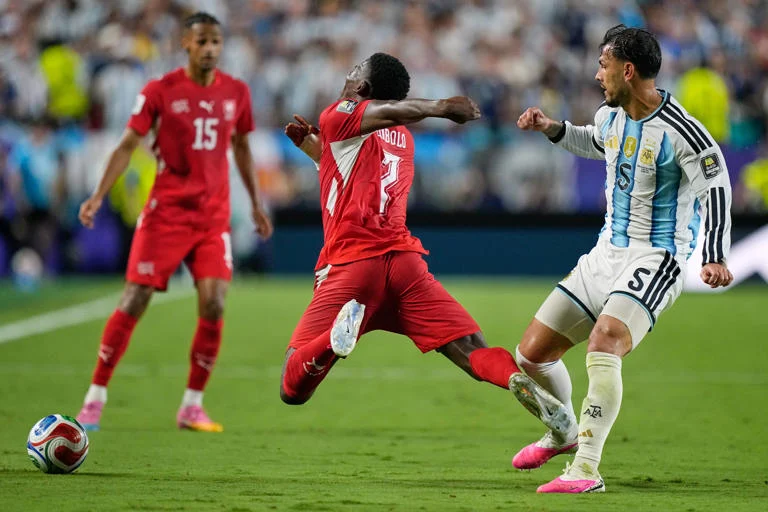 Switzerland forward Breel Embolo was sent off in the second half of its World Cup quarterfinal loss to Argentina on Saturday night, a controversial decision following a video review that is certain to fuel those who believe referees have been biased toward the reigning champion throughout the tournament. Dan Ndoye had just tied the game at 1-all in the 67th minute when Argentina’s Leandro Paredes was shown a yellow card following a tackle on Embolo. But video showed that the Swiss player was falling before Paredes made contact with him, so Embolo was given a yellow card under the “mistaken identity” protocol that’s being used at the World Cup.
Embolo also had received a yellow card earlier in the match, so he was sent off and the Swiss were left to play with 10 men the rest of the way. Switzerland managed to get the game to extra time, and was trying to survive to a shootout. But then Julián Alvarez scored from long range in the 112th minute, and Lautaro Martínez added another goal a few minutes later, sending Argentina to a 3-1 victory.
You might have noticed a certain name missing from that recap, but rest assured he was still a force, as SPORTS ILLUSTRATED’s
Lionel Messi may not have got on the scoresheet in Argentina’s World Cup quarterfinal victory over Switzerland on Saturday, but he still managed to set a record—becoming the competition’s all-time leading assist provider.
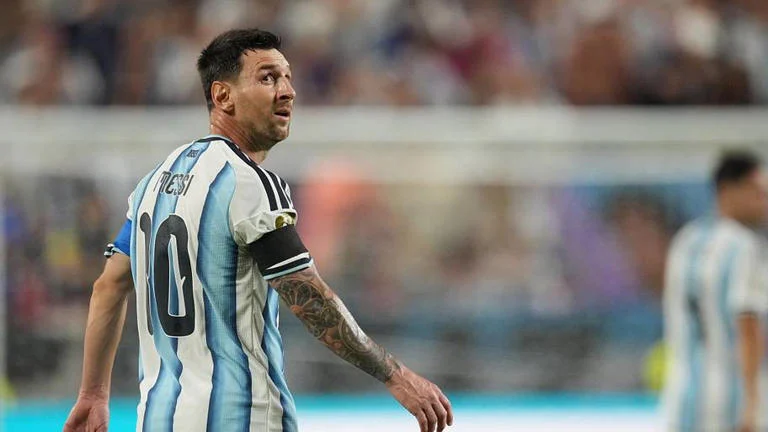 The 39-year-old set up Alexis Mac Allister’s opener in the 3–1 win with an in-swinging corner to mark his 10th assist in World Cup matches… That tally moves the Argentina captain ahead West Germany star Fritz Walter, who has nine. Brazilian great Pelé is also credited as having nine assists by some sources, but his total is widely disputed.
Interestingly, each of Messi’s assists have been provided to a different goalscorer.
The ultimate team player for what is arguably the ultimate team, and the last one remaining from the Western Hemisphere.
Three more matches of significance remain–sorry, folks, I stopped caring about third place games once the NFL and NCAA stopped playing them. All singleheaders in the afternoon. Consequential, of course. But will somehow be a tad lacking compared to the 240-plus minutes of tension and emotion we got yesterday,
Nice while its lasted, FIFA.
Courage…