

The latest renderings of a possible new Chicago White Sox ballpark are certainly capable of stirring the imagination. The proposed stadium would rise along the Chicago River as part of a massive South Loop development known as The Railyards, occupying land currently used by Amtrak between Roosevelt Road and 18th Street. It would sit across the river from the Chicago Fire’s new stadium, potentially creating the kind of concentrated sports district that Chicago has never really had.
Visually, the concept does a lot of things White Sox fans have wanted for decades. The open-air park faces toward downtown, finally using Chicago’s skyline as part of the ballpark experience. Brick walls and arches provide echoes of old Comiskey Park, while the stadium’s right-field side presses against the river with relatively little seating between the field and water. If the dimensions cooperate, the Sox could have their own version of San Francisco’s McCovey Cove, with home runs landing in the Chicago River.
There are some peculiarities. The renderings appear to show as many as five seating decks behind home plate, which could create another steep, vertically stacked stadium instead of the more intimate park many fans would prefer. Still, the surrounding development—with housing, restaurants, retail space, riverwalk access, a nearby Metra station and possible water-taxi service—offers considerably more charm than the acres of asphalt surrounding Rate Field.
However, it is important to separate an attractive concept from an actual ballpark project. No architect has been selected, and Justin Ishbia’s representatives have acknowledged that the images are merely a representation of what a modern stadium could look like. Canal Edge is only beginning a multi-month feasibility review covering transportation, environmental impact and other practical concerns. Even if the property passes those tests, the site would merely be added to the White Sox’s list of possible ballpark locations.
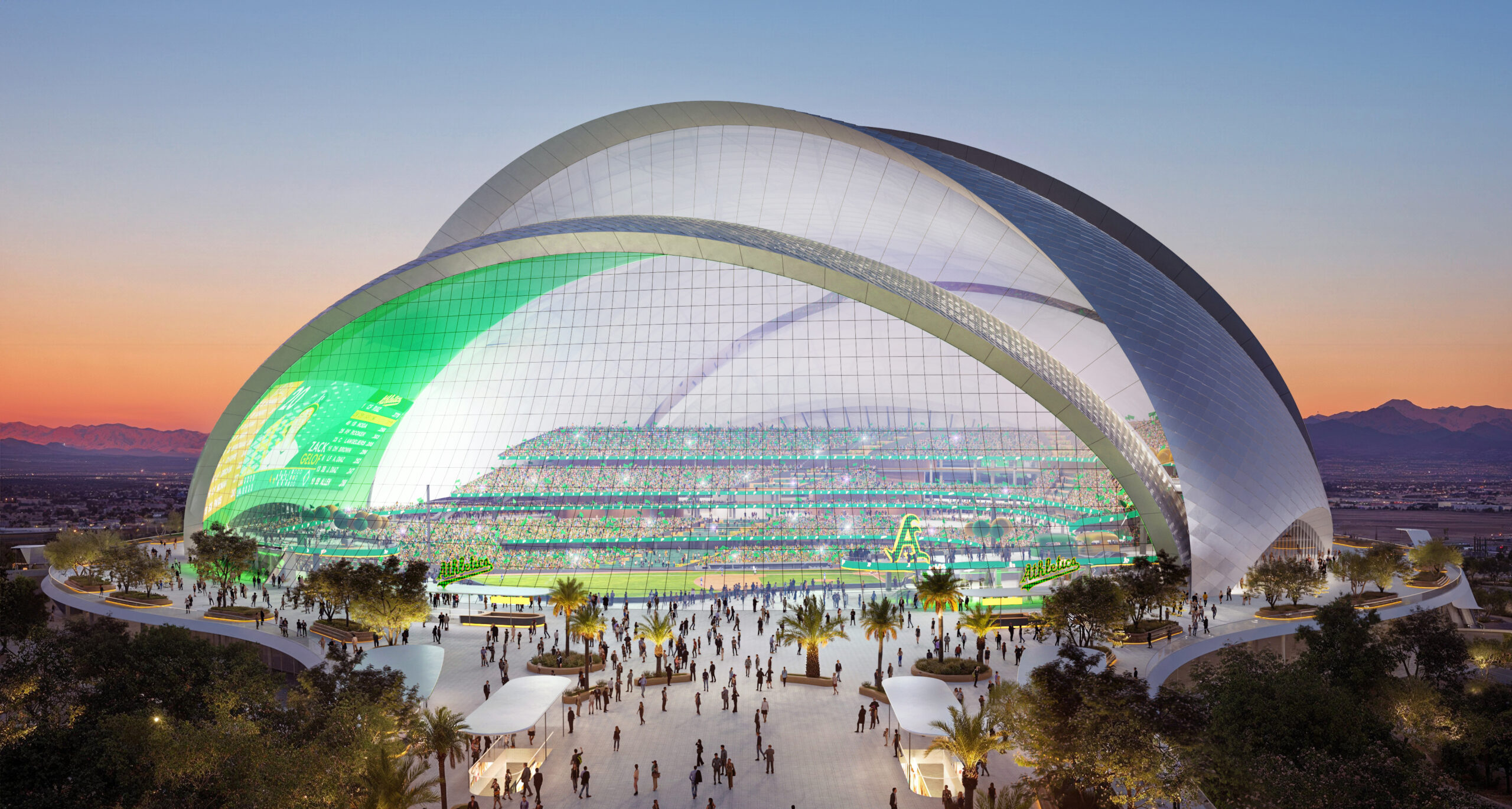
That makes the White Sox pictures dramatically different from the renderings of the Athletics’ new Las Vegas stadium. The Vegas park may look like a giant armadillo, the Sydney Opera House or an airport terminal designed for spaceships, but it is no longer hypothetical. Construction began in 2025 at the former Tropicana site, foundation work has been completed, concrete seating levels are taking shape and enormous steel trusses are being installed over the stadium. Officials continue to say it will be finished in time for the 2028 season.
The Athletics’ 33,000-seat stadium is designed specifically for its Las Vegas environment. Its fixed roof consists of five overlapping shells inspired by baseball pennants, protecting fans and players from the desert heat while allowing indirect natural light into the building. A massive cable-net glass wall will look toward the Strip, and the proposed 18,000-square-foot video board would be the largest in Major League Baseball. It is bold, futuristic and intentionally excessive—which makes it perfectly suited for Las Vegas. [mlb](https://www.mlb.com/news/a-s-unveil-renderings-for-ballpark-in-las-vegas)
The White Sox concept takes the opposite approach. Rather than competing with casinos, neon signs and spectacular resorts, it attempts to feel unmistakably Chicago. The river, brickwork, skyline and surrounding neighborhood are the attraction. The Athletics are building an enclosed entertainment venue that happens to contain a baseball field. The White Sox renderings suggest a traditional urban ballpark intended to become part of the city around it.
The most important difference, though, has nothing to do with architecture. The Athletics have made their relocation decision and are putting steel and concrete into the ground. The White Sox have not selected a site, approved a design or committed to leaving Rate Field. Their lease at the state-owned stadium expires after the 2029 season, but an expiring lease does not automatically produce a new ballpark—especially when the organization’s long-term ownership remains unsettled.
Under the agreement between Jerry Reinsdorf and Justin Ishbia, Reinsdorf has the option to sell the controlling interest from 2029 through 2033. If he does not, Ishbia receives an option to acquire control after the 2034 season. Until a transaction occurs, the Reinsdorf family retains the controlling interest, and Jerry remains the club’s sole day-to-day decision-maker. The announcement also explicitly says there is no assurance that a future ownership transaction will occur.
That is why it is reasonable to believe the White Sox will remain at Rate Field—and perhaps not move anywhere, even elsewhere in Chicago—for approximately another 15 seasons. Jerry Reinsdorf has said he intends to operate the franchise as long as he is able, and there is little reason to expect him to surrender control merely to accelerate a project being promoted by his potential successor. Unless Reinsdorf passes away and the family changes direction, or Ishbia gains control after the 2034 season, the ballpark discussion could remain stuck between beautiful pictures and preliminary studies.
Here’s the thing, folks: Even a post-2034 transfer would not produce a stadium overnight. A new controlling owner would still have to complete the land acquisition, select an architect, finalize financing, secure city and state approvals, complete environmental and transportation reviews and then build the park. That process could easily consume another four or five years, pushing a potential opening toward 2040 or 2041.
With that . . . The renderings therefore offer White Sox fans something enjoyable to debate, but not necessarily something they should expect to visit soon. Las Vegas is showing Athletics fans a stadium scheduled to open in 2028. Chicago is showing White Sox fans a vision that might become serious after 2034 and might become reality several years after that. The A’s ballpark is now a construction project. The White Sox ballpark remains an architectural daydream—beautifully rendered, strategically released and probably at least 15 seasons away.
If you do not work with them, then speculating about what they will do becomes your game!