
You’ve likely been paying more attention and devoting more viewing time to this year’s Wimbledon tournament than I am. When the fortnight began, both my physical and fiscal health was at a recent nadir, and when my French Open fave Coco Gauff became an unexpected first round upset victim, I kinda tuned out.
But as is so often the case, especially with world class Grand Slams in individually competed sports, much like the exascerbated Michael Corleone, “just when I think I’m out they pull me back in”. And naturally, it was a Jersey girl who migrated to Florida as a kid that was the reason. Isn’t that always the case?
And yesterday, as tea time approached outside London, pretty much the entire tennis-loving population of the world took note of the truth that is my life, as ESPN’s D’Arcy Maine reported:
One year ago, Amanda Anisimova was at home in Miami, spending time with friends and trying to pay as little attention to her phone as possible. And she certainly wasn’t following the results at Wimbledon.
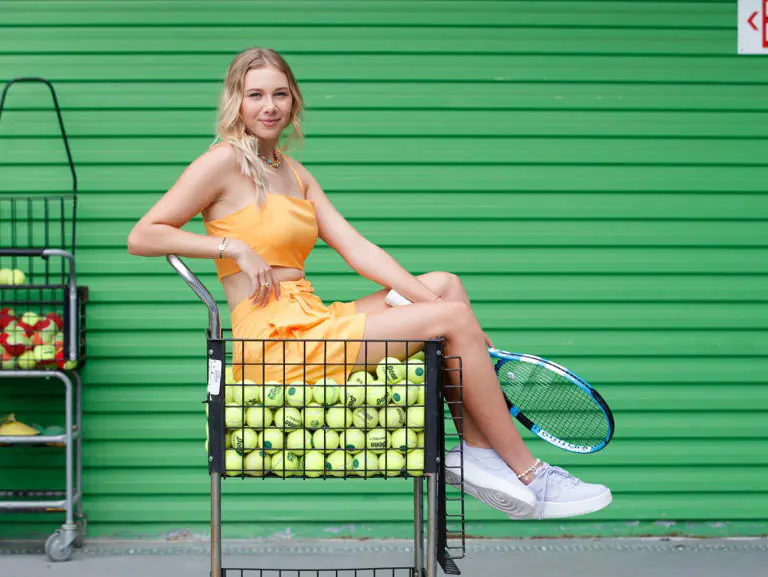 Anisimova had recently returned from an eight-month mental health break from the sport and was struggling to rediscover her place in the tennis ecosystem. People told her it would be hard for her to return to the top of the game — she had reached the quarterfinals at Wimbledon in 2022 — and to the point, they had been right. But that was then.
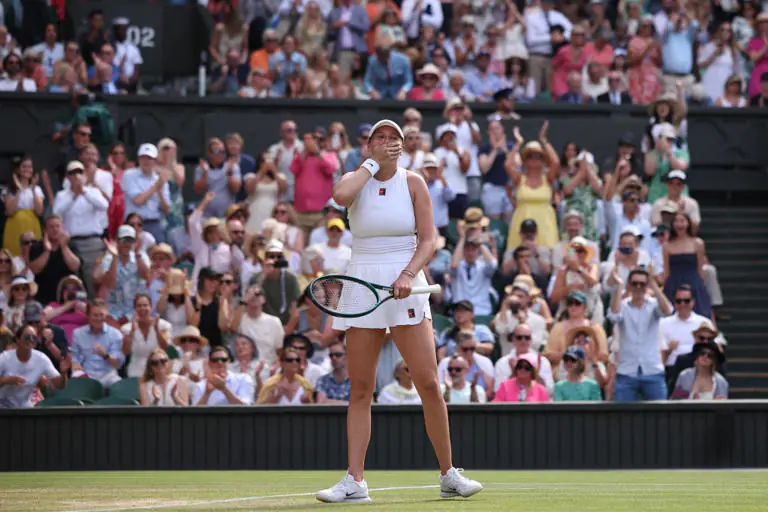
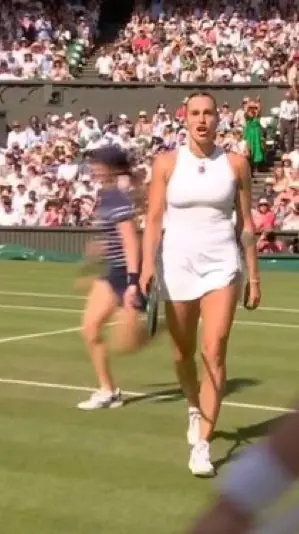 On Thursday, playing in the stifling afternoon heat on Centre Court against No. 1 Aryna Sabalenka, the No. 13 seed Anisimova took the latest unforeseen step in a career full of them, as she pulled off the staggering upset, 6-4, 4-6, 6-4, to advance to her first major final. The crowd, which seemed to be holding their collective breath throughout the deciding set, showered her with a rousing ovation after the two-hour, 37-minute match was finally over.
THE NEW YORK POST’s Jenna Lemoncelli shed some light on exactly who this upstart is and a little more context as to exactly how shocking this turn of events was:
It has been an incredible journey for Anisimova from reaching the French Open semifinal as a 17-year-old from a recent mental health break to now reaching the precipice of tennis immortality on the grass courts on the All England Club.
“I’ve really been struggling with my mental health and burnout since the summer of 2022,” the then-21-year-old wrote on Instagram. “It’s become unbearable being at tennis tournaments. At this point, my priority is my mental well-being and taking a break for some time. I’ve worked as hard as I could to push through it. I will miss being out there, and I appreciate all the continuous support.”
The 23-year-old, who hails from Freehold Township, N.J., now becomes the youngest American woman to reach the Wimbledon singles final since Serena Williams in 2004.
But it was not merely the fact that Anisimova conquered her personal demons as well as the #1 tournament seed. It was the fact that she did so in a way where she also was able to quell a frustrated bully in the process. SPORTS ILLUSTRATED’s Tim Capurso explained:
There was a bit of a tense moment during Aryna Sabalenka’s stunning 4-6, 6-4, 4-6 semifinal loss to world No. 12 Amanda Anisimova on Thursday.
Sabalenka, after dropping the first set, stormed back to win the second, then found herself down 4-2 and 30-40 in a pivotal game with Anisimova on serve. The two traded several backhand blows from the baseline, then Anisimova, going for broke, struck a big forehand down the line. The ball clipped the net and landed short, catching Sabalenka off guard. The world No. 1 was unable to return the ball and Anisimova won the game to take a commanding 5-2 lead in the set, one she would not relinquish.
After winning the point, Anisimova raised her left arm in the air in celebration. Meanwhile, as the two players changed sides, the ESPN broadcast showed an irked Sabalenka asking Anisimova why she “didn’t say sorry” after her winner clipped the net. Broadcasters Chris Fowler and Chris Evert even made note to point it out.
“Interesting exchange,” Fowler said. “This is Sabalenka at the end of the last game. ‘Why didn’t you say sorry?’ She appears to say to Anisimova, whose shot hit the tape and went over.”
“I’ve never heard that anybody would question that. Not everyone says sorry,” said Evert.
Certainly not talented Floridians named Chris. Or anyone who shares other qualities with any such folk.
And now it sets up a truly monumental clash at breakfast time Saturday morning, as Maine expounded:
 Now, playing against five-time major champion Iga Swiatek, Anisimova will have a chance to win the first Grand Slam title of her career on Saturday. Remarkably, it will be the first tour-level meeting for Anisimova and Swiatek. They’ve played against one another only once before in the 2016 Junior Fed Cup final, in which Swiatek defeated Anisimova, 6-4, 6-2 to help Poland take the title. Swiatek, a five-time major champion, has had her long-awaited breakthrough on grass during the fortnight. She had previously never advanced past the quarterfinals at the tournament but has been dominant this year. She’s dropped just one set en route to the final and routed Belinda Bencic, 6-2, 6-0 in Thursday’s other semifinal.
And thanks to the time zone difference and the fact that my stomach is finally settling down enough for me to have something resembling a more normal sleep cycle, I’ll be able to see this epic battle and potential coronation of a new American tennis queen live. I might even fix me some strawberries and creme for the occasion. Just allow me to break tradition enough to use the reduced fat creme. It’s much easier on the stomach.
Courage…