
I had every intention of dual-illuminating this on our sister site Leblanguage today, since in the overlapping worlds of sports and media this is a pretty big deal. But as you may have heard late yesterday the new face of the First Amendment–ironically a one-time FOX Sports pre-game host–made a bit of pre-emptive news of his own. The fact we’re practically inviting you to click there at the outset would suggest its magnitude.
But in the otherwise humdrum world of TV sports and its measurement, there’s actually a lot of good news abounding. AWFUL ANNOUNCING’s Drew Lerner shared some of it yesterday, and a couple of nuggets in his bags should help make the folks now programming CELEBRITY FAMILY FEUD in late night a little less sad:
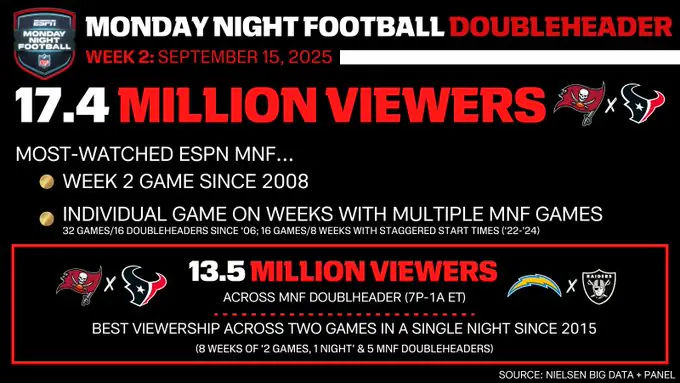 Game 1 of ESPN’s Monday Night Football doubleheader averaged 17.4 million viewers as the Tampa Bay Buccaneers won a tight game against the Houston Texans. The game was also simulcast on ABC. Per ESPN, it was the most-watched Week 2 game on the network since 2008. Game 2 of the doubleheader, featuring the Los Angeles Chargers and Las Vegas Raiders, which aired only on ESPN, averaged 9.7 million viewers for the 10 p.m. ET kickoff.
Put in perspective, the actual audience for what may have been Jimmy Kimmel’s final night of employment was in the neighborhood of 1.77 million total viewers–or less than a fifth the size of who watched a rather lackluster game in the same daypart on a sister Disney network .
And that wasn’t the only NFL licensee crowing about ratings, either, Witness these back-slappers: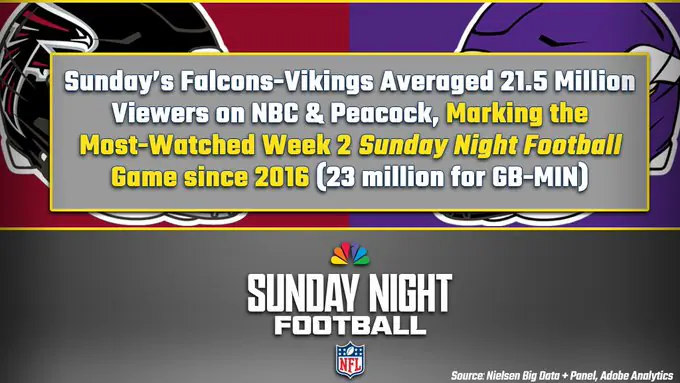
But it’s the one that started this record-breaking weekend that has caused more consternation and produced arguably the most significant sports asterisk since the days of Roger Maris chasing Babe Ruth. Per SPORTS MEDIA WATCH’s Jon Lewis from earlier this week:
The season premiere of NFL “Thursday Night Football” may provide the clearest indication yet of the ambiguity of viewership measurement in 2025…Amazon Prime Video averaged 17.76 million viewers for Packers-Commanders on the season premiere of “Thursday Night Football,” which is officially the largest audience for “TNF” since it moved to Prime Video. The previous high was 17.29 million for Packers-Lions last December.
 But the comparison is apples-to-oranges. The Packers-Commanders figure is based on the Nielsen “Big Data + Panel” metric, which combines the traditional Nielsen panel with data from set-top boxes and smart TVs. Under Nielsen policy, networks are to compare this year’s “Big Data + Panel” figures to last year’s panel-only data.
And Lerner made sure to put that asterisk in bold type and in a larger font in his cautionary note:
It is important to reiterate, Nielsen’s new methodology creates very favorable conditions for historical comparisons. Multi-year highs should be the expectation for all live sports properties throughout the next 12 months. Anything less would be cause for great concern among leagues and networks.
So down is apparently no longer the new up; apparently some form of up could be the new down.
But it’s the news from the prior week’s streaming-exclusive game that has the czars of old school networks up in arms. It all started nearly two weeks ago when FRONT OFFICE SPORTS’ Eric Fisher dropped this story:
Even before YouTube streams its NFL game Friday night in Brazil between the Chiefs and Chargers, other league rights holders are crying foul over the Nielsen viewership count that hasn’t been released yet.
“Nielsen’s measurement of tonight’s YouTube game will not be made available to other Nielsen clients, a flagrant departure from Nielsen’s history of transparency and a slap in the face to longstanding clients,” Fox Sports president of insights and analytics Mike Mulvihill tweeted late Friday afternoon. “When it comes to streamers, the rules simply don’t apply.”
He continued, “Nielsen’s strength isn’t in perfect accuracy, I don’t say that in a snarky way. Their value comes from impartiality and transparency. When they move away from those tenets they undermine what makes them the only essential data source in media.”
Fortunately, the likes of MASHABLE’s Cecily Mauran were available to scratch Mulvihill’s itch come the following Monday morning:
YouTube’s exclusive rights to the first Friday night game of the NFL season seems to have paid off. Over 17.3 million football fans watched the exclusive NFL broadcast on YouTube TV last Friday, according to Google (via Variety). YouTube told Variety the 17.3 million stat included 1.1 million viewers outside of the U.S., with 16.2 million views across YouTube and other distribution platforms in the U.S.
Were that story to have ended there, we all might be able to go on with our lives. But sho ’nuff, it did not. Fisher picked up the narrative later in the week:
The already-fractious debate over viewership of YouTube’s NFL game on Sept. 5 has taken another major turn as the streamer has revised its audience figures, reigniting tensions around the measurement.
Four days after initially announcing a global audience of 17.3 million for the Chiefs–Chargers game from Brazil, YouTube disclosed late Friday an adjusted figure of 19.7 million. The new breakdown includes U.S. viewership of 18.5 million and 1.2 million elsewhere around the world. The company said the update became necessary after discovering “an internal technical issue” in its metrics.
“A subset of legitimate views were not categorized as actual views. As a result, the viewership numbers for this game were undercounted,” YouTube said in a blog post. “We’ve revalidated the numbers with Nielsen, after providing them with the updated first-party data. This is an unfortunate situation, and we’ll do better next time.”
 In his latest broadside against YouTube, Fox Sports president of insights and analytics Mike Mulvihill likened the audience revision to Donald Trump’s attempts to change Georgia voting results in the 2020 U.S. presidential election. “So what are we going to do here folks? I only need 11,000 votes,” Mulvihill tweeted, parroting Trump’s comments at the time to Georgia’s secretary of state Brad Raffensberger. “Give me a break.”
Only this time the ever razor-sharp Mulvhill has a comrade in arms, as Fisher noted in both of his reports:
ESPN SVP of research Flora Kelly picked up the narrative with her own broadside against Nielsen…“With the start of football comes Nielsen changes (Big Data, new times, etc.),” Kelly tweeted. “And the latest wrinkle: a custom methodology Nielsen created for YouTube’s NFL game. Not the same approach as the rest of us, nor [Media Rating Council] accredited. Conclusion … their rating is not a fair comp.”.
 Kelly, now nearly a 20-year veteran of the ESPN battlefield herself and a disciple of one of the savviest and most decent research czars I’ve ever known in Artie Bulgrin, retweeted Mulvihill’s Trump snark, which given recent events I’d like to hope she’s at least consulted Kimmel’s legal team about.
But both of these esteemed researchers are quite spot on when they accuse Nielsen of coddling their well-heeled newer clients. There was once a time when both of their companies were upstarts and methodological changes helped grow their businesses. When local markets became metered and ABC just happened to own ones that disproportionately benefitted the halo effect on the network that ultimately saw it become number one was crystal clear. When Nielsen rolled out peoplemeters at roughly the same time that the FOX network was born the immediate impact and value of being number one in young adults helped accelerate the decision for FOX to invest in NFL rights in the first place.
That was a generation ago, and now FOX is the mature adult in the room trying to call a fair game. Good luck with that.
If you were the overmatched Nielsen CEO Karthik Rao and you were attempting to grow a business that your fellow investors were in neck deep to the tune of $16 billion who would you be making nice to?
Indeed, it was the partnership with Amazon and the first-party data they began to share with Nielsen when they first acquired TNF rights that finally got Nielsen to move its tuchas and at last launch the long-rumored Big Data inclusion that has everybody looking at plus signs and up arrows this year.
But if you’re someone like Mulvihill, you’re gonna make damn sure you’re relentless in keeping as much transparency and honestly out there for everyone, and not just for football games, either. Especially when you’re also competing against upstart ratings services ironically run by your former FOX colleague. Witness what what Fisher and his colleagues David Rumsey, and Colin Salao shared in their morning newsletter which popped into our inbox mere minutes ago:
Just as one high-profile fight around sports viewership metrics is calming down, another one is beginning.
Netflix said it attracted a global average audience of 36.6 million for last weekend’s boxing match between Terence Crawford and Canelo Alvarez, a bout that also set a series of attendance and gate records in Las Vegas. That streaming audience included an average minute audience of 20.3 million viewers in the U.S.
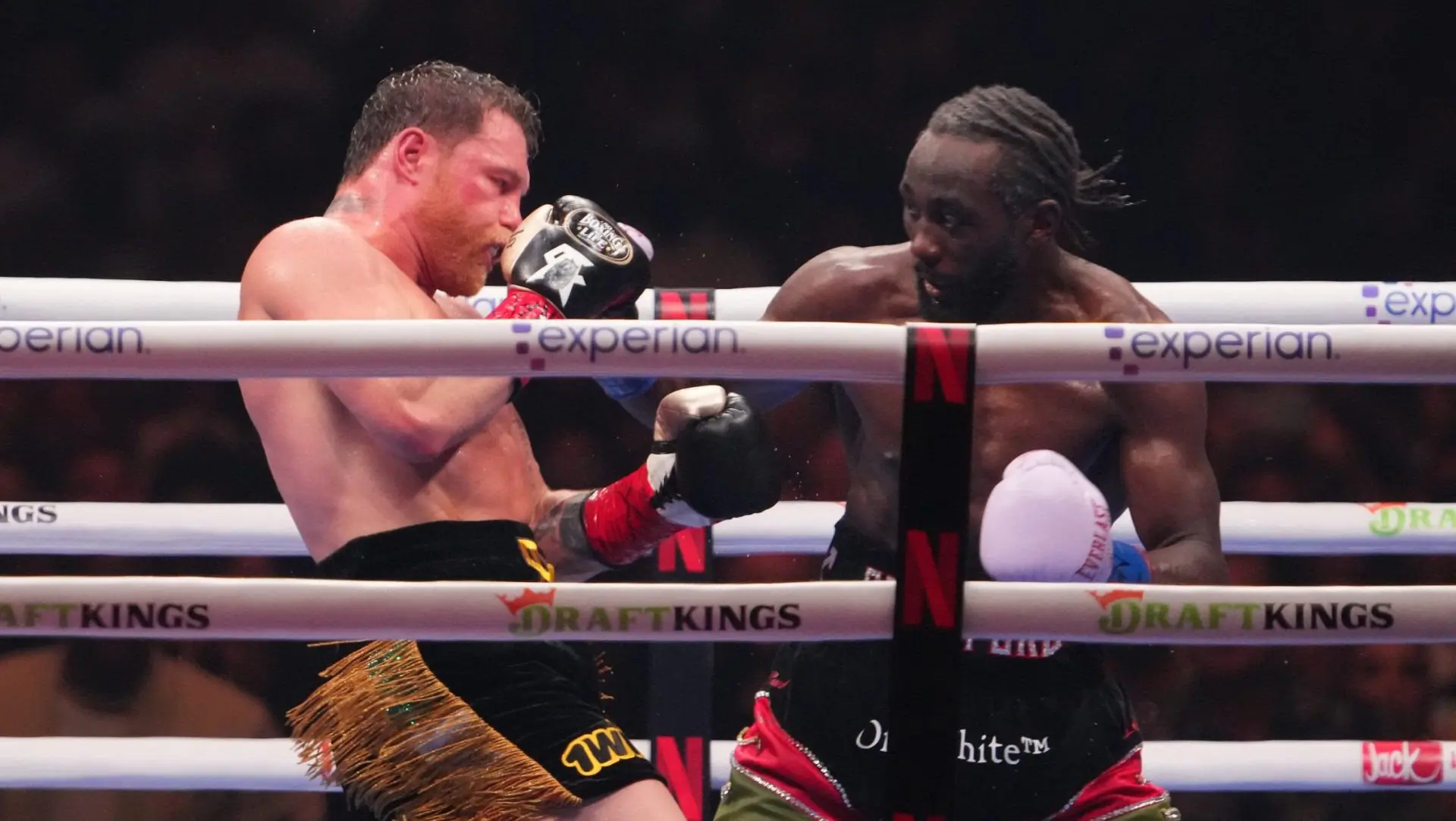 Those metrics, however, were the result of a combination of internal, non-audited data and measurement from VideoAmp, a challenger to Nielsen that has not received accreditation from the Media Ratings Council. The process used by Netflix was the same as one used last fall for its live stream of the Mike Tyson-Jake Paul fight, metrics that were dismissed by many others in the business of sports as not particularly reliable.
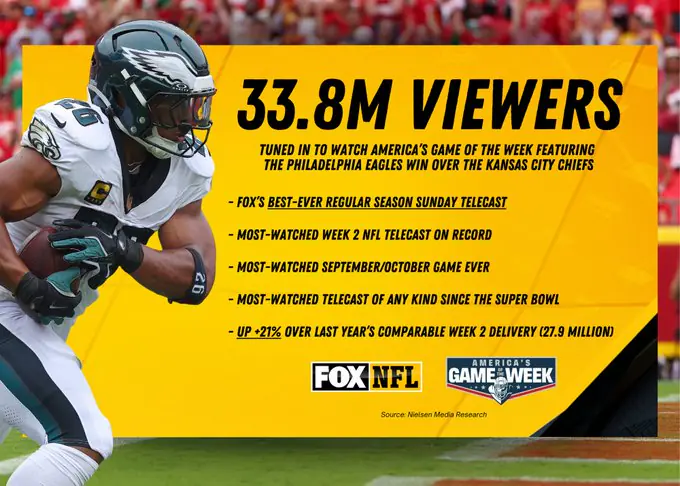
Along similar lines, the Netflix number for a boxing match happening after midnight early Sunday on the U.S. East Coast on a subscription-based streaming service was similar to the average of 33.8 million for last weekend’s Super Bowl rematch. That NFL game was played late on a Sunday afternoon with two of the league’s most popular teams and was fundamentally based on broadcast television. As a result, Netflix’s claim, to some, does not make sense.
“The Eagles-Chiefs number is pretty good, but just imagine if it had been on at 1 a.m. and measured by VideoAmp,” tweeted Fox Sports president of insights and analytics Mike Mulvihill.
Damn, Mike, that’s funny. I hear there’s an opening for a politically indifferent late night talk show host that just opened up.
Courage…