
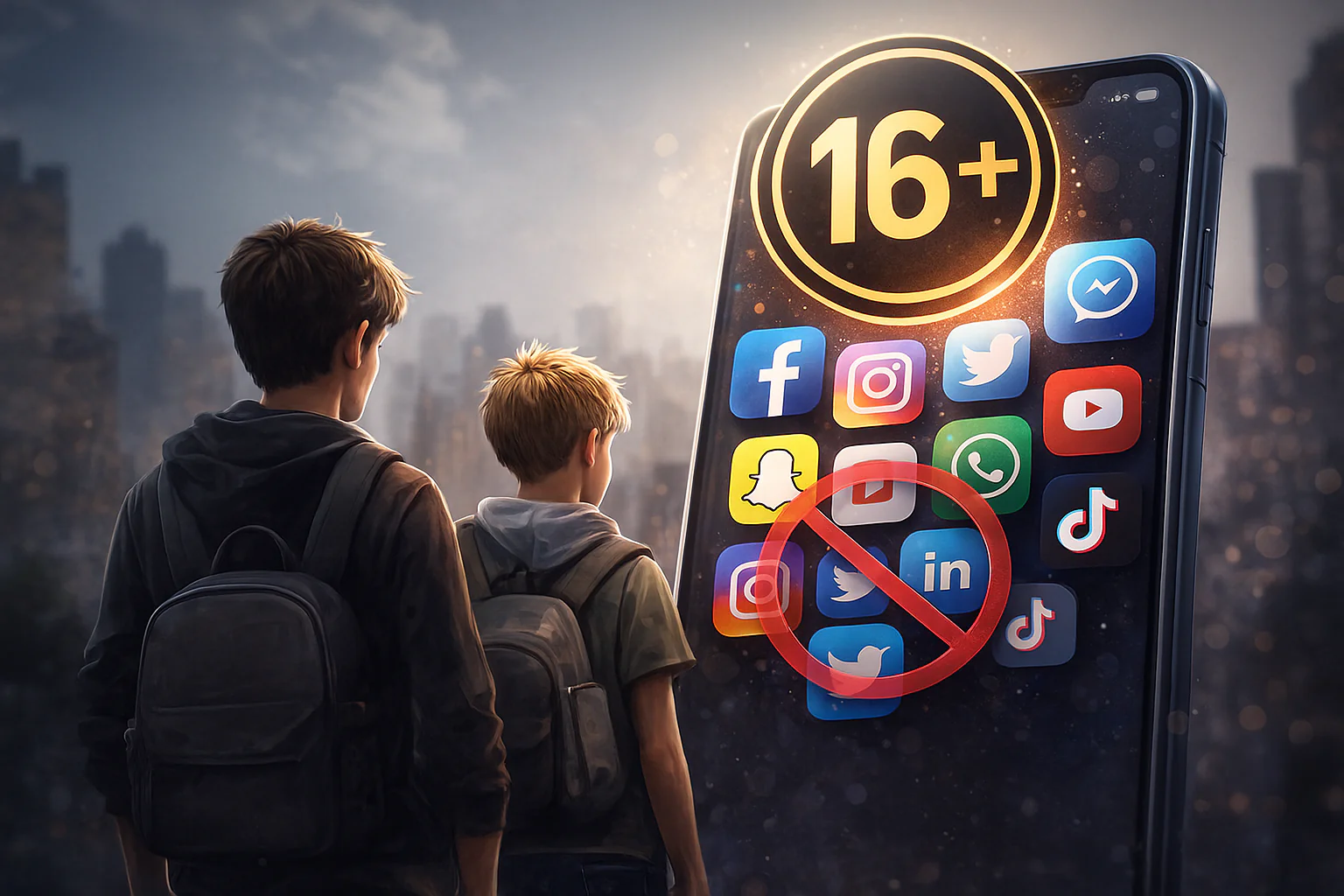
Over the past year, a global conversation has emerged about age restrictions on social media, and governments worldwide are starting to take bold action. A law will go into effect on December 10, 2025 in Australia making them the first country to pass sweeping legislation banning social media use for anyone under 16. This isn’t just an isolated case though — many countries are following suit or considering similar measures as evidence mounts about the potential harms social media poses to young people. It’s a fascinating moment where policy and technology intersect, and there’s growing optimism that these changes could meaningfully improve mental health outcomes for children.
Australia’s groundbreaking legislation represents the most aggressive approach to date. Starting in just over two weeks Social media platforms will be required to take reasonable measures to prevent users under the age of 16 in Australia from establishing accounts, as well as to deactivate or eliminate existing accounts that already exist. The Australian government describes this ban as pioneering policy globally and says it’s designed to mitigate the pressures and dangers that children face on social media, particularly from design elements that encourage prolonged screen time while exposing users to content that may adversely affect their health and wellbeing. Meta has already announced plans to start shutting down Instagram and Facebook accounts for Australian teens beginning December 4, with affected users receiving notifications to save their data before deletion.
Europe is closely following Australia’s lead with its own legislative initiatives. Denmark has announced a landmark agreement to prohibit social media access for children under the age of 15, though parents will have the option to grant permission for 13- and 14-year-olds on a case-by-case basis. Denmark’s Minister for Digital Affairs, Caroline Stage, revealed that 94 percent of Danish under-13s and over half of those under 10 already maintain social media profiles, highlighting just how pervasive the problem has become. France passed a law on June 29, 2023, requiring social media platforms to verify user age and obtain parental consent for those under 15, with companies facing fines of up to 1% of global revenues for violations. Spain’s government approved a draft law in June 2024 raising the age of data protection consent for social media accounts from 14 to 16. Norway is currently evaluating a similar measure and has already announced its intention to raise existing social media age restrictions from 13 to 15. Greece followed suit in December 2024, announcing planned regulations requiring mandatory age checks and parental controls for users under 15.
In the United States, the situation is more complex. Most social media platforms currently require users to be at least 13 years old, consistent with federal law established by the Children’s Online Privacy Protection Act (COPPA). However, enforcement has proven challenging. A federal judge blocked an attempt in Utah to prohibit under-18s from using social media without parental consent last year, suggesting that implementing even more restrictive policies in the U.S. could face legal challenges.
The rationale behind these global restrictions is rooted in substantial research about social media’s impact on child mental health. The U.S. Surgeon General released an advisory in spring 2023 titled Social Media and Youth Mental Health, raising concerns about the amount of time adolescents spend on platforms, the type of content they consume, and how social media disrupts essential health activities like sleep and physical activity. The advisory highlighted that the brain undergoes a highly sensitive developmental period between ages 10 and 19, when identities and feelings of self-worth are forming. Research indicates that frequent social media use may be associated with distinct changes in the developing brain, potentially affecting emotional learning, impulse control, and emotional regulation. Rates of depression and anxiety among youth have surged in parallel with increasing social media engagement, creating what experts describe as a public health crisis.
Research from Johns Hopkins University notes that teens who started social media at age 10 or younger were more likely to be victims of online harassment, more likely to have friends or follow accounts that parents would disapprove of, and more likely to display unsympathetic online behaviors like sharing fake content or engaging in cyberbullying. Some researchers have been remarkably candid about the severity of the issue. In interviews, some experts have stated they would rather give their children cigarettes than social media because at least there’s social pressure to stop smoking. Laura Clary, an assistant research professor at Johns Hopkins Bloomberg School of Public Health, emphasizes that even those three additional years between age 13 and 16 represent a critical developmental period.
The mental health benefits of these age restrictions could be substantial. By delaying social media exposure until age 16, jurisdictions hope to allow young brains to develop further before encountering algorithmic engagement tactics designed by some of the world’s brightest engineers specifically to maximize screen time and engagement. These algorithms exploit adolescent psychology, making teenagers particularly vulnerable to extended use and harmful content. Restricting access earlier in development means young people gain additional years of maturity, emotional regulation skills, and self-identity formation before facing these manipulative design patterns.
Here’s the thing, folks: While critics do raise some concerns about these restrictions, particularly regarding implementation challenges and potential overreach. According to the Information Technology and Innovation Foundation, enforcing such bans poses significant technical and practical difficulties, and the measures lack exceptions even for situations where parents have granted permission. There are also concerns about privacy implications when platforms use increasingly intrusive age verification methods, and questions about whether the restrictions might inadvertently push young people toward less regulated online spaces.
With that… Despite these challenges, the global momentum behind age restrictions on social media continues growing. Australia’s approach has galvanized international action, with more countries contemplating or implementing similar measures. The core premise remains compelling: if restricting social media access until age 16 can reduce anxiety, depression, cyberbullying, and other mental health harms that plague young people today, the inconvenience of implementation seems justified. As societies grapple with what many are calling an adolescent mental health crisis, these age restrictions represent a significant policy shift acknowledging that not everything that technology makes possible is beneficial for developing minds. Whether these restrictions ultimately succeed in improving child mental health will likely influence policy decisions globally for decades to come.
When you use technology daily you should take your own mental health into account as a way to motivate those younger folks around you to use their time differently.